gûarinĩnamo só
Old Tupi
Alternative forms
- gûarinĩramo só, ûarinĩ só
Etymology
The first part comes from gûarinĩ (“warrior”) + -namo (“as / in the condition of”), so that the full expression with só (“to go”) means, literally, “to go as / in the condition of [a] warrior”.
Pronunciation
- Hyphenation: gûa‧ri‧nĩ‧na‧mo só
Verb
gûarinĩnamo só (first-person singular active indicative gûarinĩnamo asó / gûarinĩnamo xe sóû, first-person singular negative active indicative gûarinĩnamo n'asóî / gûarinĩnamo xe soe'ymi, noun gûarinĩnamo só)
- (intransitive, idiomatic) to go to war, to wage war[1]
- Synonyms: gûarinĩ, marãmonhang, marana ri ikó
- 1578, Jean de Léry, chapter XIX, in Histoire d'un voyage fait en la terre du Bresil, autrement dite Amerique [History of a voyage to the land of Brazil, also called America] (overall work in Middle French), La Rochelle: Antoine Chuppin, page 353:
- Nereſco-icho pirem-ouariui?[sic – meaning ouarini]
- [N'eresóî xóp'irã ûarinĩ[namo]?]
- Won't you go to war in the future?
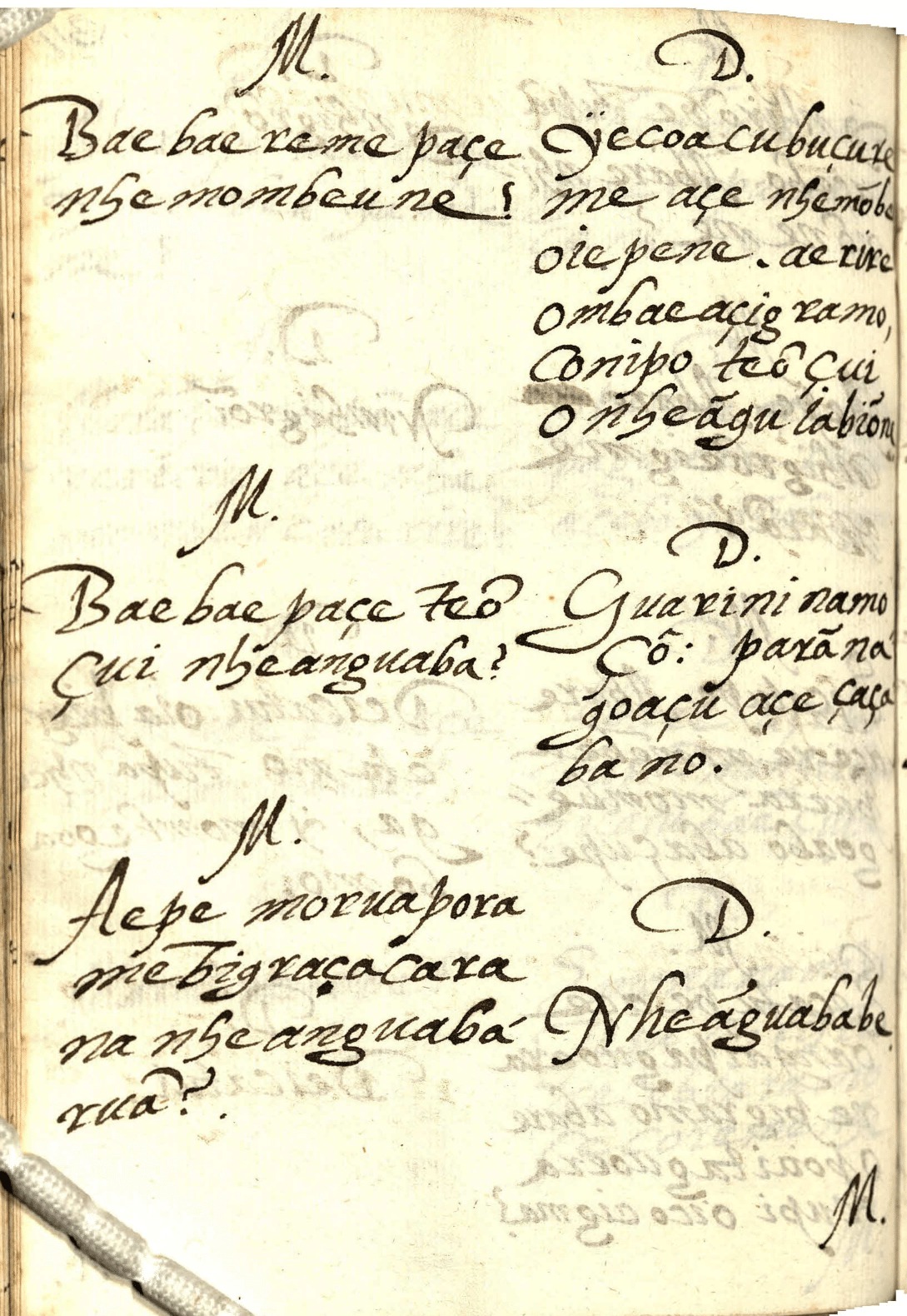
- a. 1591, anonymous author, “Da confiſsaõ”, in Doutrina christaã na linguoa Brasilica [Christian Doctrine in the Brasílica Language][1], page 33v:
- Bae bae paçe teȏ çui nheanguaba? / Guarini namo çô: parãnagoaçu açe çaçaba no.
- [Mba'emba'ep'asé te'õ suí nheangûaba? / Gûarinĩnamo só, paranãgûasu asé sasabano.]
- What are the occasions when the people fear death? / The going to war [and] the crossing of the ocean by the people as well.
- 16th century, Joseph of Anchieta, “[Confissão]”, in [Doutrina Cristã]; republished as Armando Cardoso, compiler, Doutrina Cristã: Catecismo brasílico, volume 1, São Paulo: Loyola, 1992, →ISBN, page 212, line 33:
- Oñemombeúpe abá guarininamo osó janondé, ygarusúpe oári janondé?
- [Onhemombe'upe abá gûarinĩnamo o só îanondé, ygarusupe o 'ary îanondé?]
- Does someone confess themselves before going to war [and] before embarking on a ship?
- 1618, Antônio de Araújo, “Do Sacramento da Penitencia” (chapter VII), in Cateciſmo na Lingoa Braſilica [Catechism in the Brazilian Language], 1 edition, Livro Quinto do Cathecismo, e summa da Doctrina Christam [… ] (overall work in Old Tupi, Portuguese, and Latin), Lisbon: Pedro Crasbeeck, page 91:
- Baè baèpiã teõ çuî nheangoâbo?[sic – meaning nheangoâba] / Guarininamoçô, paranãgoâçu raçâbano.
- [Mba'emba'epiã te'õ suí nheangûabo? / Gûarinĩnamo só, paranãgûasu rasabano.]
- What by chance are the occasions to fear death? / Going to war [and] crossing the ocean as well.
- 1622, anonymous author, “Guerrear, Bellum gerere”, in Vocabulario na lingoa Braſilica, volume 1 (overall work in Old Tupi and Portuguese), Piratininga, page 152; republished as Carlos Drummond, editor, Vocabulário na Língua Brasílica, 2nd edition, São Paulo: USP, 1953:
- Aço guarinĩramo.
- [Asó gûarinĩramo.]
- I go to war.
References
Further reading
- Navarro, Eduardo de Almeida (2013), “gûarinĩ”, in Dicionário de tupi antigo: a língua indígena clássica do Brasil [Dictionary of Old Tupi: The Classical Indigenous Language of Brazil] (overall work in Portuguese), São Paulo: Global, →ISBN, page 135, columns 1–2