hors
Danish
Etymology
From Old Danish hors, Old Norse hross n, from Proto-Germanic *hrussą, cognate with English horse, German Ross n.
Pronunciation
- IPA(key): [ˈhɒːs]
Noun
hors n (singular definite horset, plural indefinite hors)
- (archaic, poetic, dialect) horse, mare
- 1906 Johs. V. Jensen, Digte, 20
- Christofer Columbus fra han var Dreng \ befandt sig bedst \ paa det blaa Hors med den hvide Man
- “Since he was a boy, Christopher Columbus \ was at his best \ on the blue horse with the white mane”
- 1906 Johs. V. Jensen, Digte, 20
Declension
| neuter gender |
singular | plural | ||
|---|---|---|---|---|
| indefinite | definite | indefinite | definite | |
| nominative | hors | horset | hors | horsene |
| genitive | horss | horsets | horss | horsenes |
Dutch
Etymology
From Middle Dutch hors, from Old Dutch hors, from Proto-West Germanic *hross, from Proto-Germanic *hrussą. Doublet of ros.
Pronunciation
- IPA(key): /ɦɔrs/
Audio: (file) - Hyphenation: hors
- Rhymes: -ɔrs
Noun
hors n (plural horsen, diminutive horsje n)
- (rare, dialectal, now mostly found in names) horse
- 1558, Gaathije Pietersz, "Inventaris, gemaeckt den IVen Januarii anno XVC acht ende vijftich", in Anne Hallema, "Nogmaals een drietal inventarissen van Franeker burgers en boeren kort na 1550", Bijdragen en Mededeelingen van het Historisch Genootschap, Vol. 49, 1928, 286.
- Een coopbrief ende quitantie, gepasseert by Fopke Wopkezn. ende Hessel Thomaszn., als mombers tot Jacob Pieterszoons weesen, aen Jan Jacobszn. ende Anne Jans dochter, vanden huijsinge te Syaerda, mit hecken, heckpalen, van noch vijftien koeijen, twee rieren, een os, twee horsen ende andere dieren, alles gecoft ende betaelt voer vier hundert ende anderhalf gouden guldens, sijnde in date den XXIen Novembris anno 1549;
- 1897, Guido Gezelle, “Twee horsen”, in Rijmsnoer om en om het jaar:
- Ze stappen hun’ bellen al klinken, / de vrome twee horsen te gaar;
- (please add an English translation of this quotation)
- 1942, Cor Bruijn, Een gave van God, Uitgeverij Ploegsma, section 16:
- Het hors zet aan, Gossen valt terug op zijn zitplaats.
- (please add an English translation of this quotation)
- 2009, Henk Gras, ‘Een stad waar men zich koninklijk kan vervelen?’ De modernisering van de theatrale vermakelijkheden buiten de schouwburg in Rotterdam, circa 1770-1860, Uitgeverij Verloren, 218, quoting Scaramouche, Scaramouche en zijne Vrienden op de Rotterdamsche Kermis, 1815, 15 & 16.
- Een zekere BERG bragt een lomp stuk HOUT voort; dit hout vormde zich tot allerlei gedaantes, en bekwam die eindelijk van Palvenier, nu beklom hij den Bok en achtte zich gelukkig de horsen van anderen voorttezwepen; dan zijne onrustige geaartheid deed hem van den bok tuimelen;
- (please add an English translation of this quotation)
- 1558, Gaathije Pietersz, "Inventaris, gemaeckt den IVen Januarii anno XVC acht ende vijftich", in Anne Hallema, "Nogmaals een drietal inventarissen van Franeker burgers en boeren kort na 1550", Bijdragen en Mededeelingen van het Historisch Genootschap, Vol. 49, 1928, 286.
Synonyms
Faroese
Etymology
From Old Norse hors, from Proto-Germanic *hrussą (“horse”), from Proto-Indo-European *ḱers- (“run”).
Noun
hors n (genitive singular hors, plural hors)
Declension
| singular | plural | |||
|---|---|---|---|---|
| indefinite | definite | indefinite | definite | |
| nominative | hors | horsið | hors | horsini |
| accusative | hors | horsið | hors | horsini |
| dative | horsi | horsinum | horsum | horsunum |
| genitive | hors | horsins | horsa | horsanna |
French
Etymology
Inherited from Middle French fors, from Old French fors, from Latin forīs, or more likely derived from dehors (in Middle and Old French defors).
Pronunciation
- (aspirated h) IPA(key): /ɔʁ/
Audio; “hors de”: (file) Audio (France (Vosges)): (file) - Homophones: or, ore, ores, ors
Preposition
hors
- (obsolete except in set phrases) outside
- hors la ville ― outside the city
- (literary, dated) apart from, if not, except, but
- 1830, Stendhal, Le Rouge et le Noir [The Red and the Black]:
- Tout son courage l’avait quitté dès qu’il n’avait plus eu à craindre le danger de rencontrer un homme; tout avait disparu de son coeur, hors l’amour.
- Every hint of courage had left him after he knew he needed no longer fear the meeting of a man; it had all vanished from his heart, all but love.
Usage notes
- Mostly displaced by hors de and en dehors de.
Derived terms
Related terms
Further reading
- “hors”, in Trésor de la langue française informatisé [Digitized Treasury of the French Language], 2012.
Gothic
Romanization
hōrs
- romanization of 𐌷𐍉𐍂𐍃
Middle English
Etymology 1
From Old English hors, from Proto-West Germanic *hross, from Proto-Germanic *hrussą (“horse”), from Proto-Indo-European *ḱers- (“run”).
Alternative forms
Pronunciation
- IPA(key): /hɔrs/
Noun
hors (plural hors or horses or (rare) horsen)
- a horse (especially male and fully-grown)
- c. 1335-1361, William of Palerne (MS. King's College 13), folio 36, recto, lines 2177-2179; republished as W. W. Skeat, editor, The Romance of William of Palerne[1], London: Kegan Paul, Trench, Trübner & Co., 1867, →OCLC, page 74:
- þan haſtely hiȝed eche wiȝt · on hoꝛſe ⁊ on fote / huntyng wiȝt houndes · alle heie wodes / til þei neyȝyed ſo neiȝh · to nymphe þe ſoþe
- Then each man went quickly, hunting with hounds amongst tall trees, on horse and on foot, until he came close enough to notice the truth.
- 1387–1400, [Geoffrey] Chaucer, “Here Bygynneth the Book of the Tales of Caunt́burẏ”, in The Tales of Caunt́bury (Hengwrt Chaucer; Peniarth Manuscript 392D), Aberystwyth, Ceredigion: National Library of Wales, published [c. 1400–1410], →OCLC, folio 9, verso, lines 597-599:
- Hıs loꝛdes sheep[e] / hıs neet / hıs daẏerẏe / Hıs swẏn / hıs hoꝛs / hıs stooꝛ / and hıs pultrẏe / Was hoollẏ / ın thıs Reues gou[er]nẏnge […]
- His lord's sheep, beef herd, dairy herd, / swine, horses, livestock, and poultry, / were entirely under this reeve's control […]
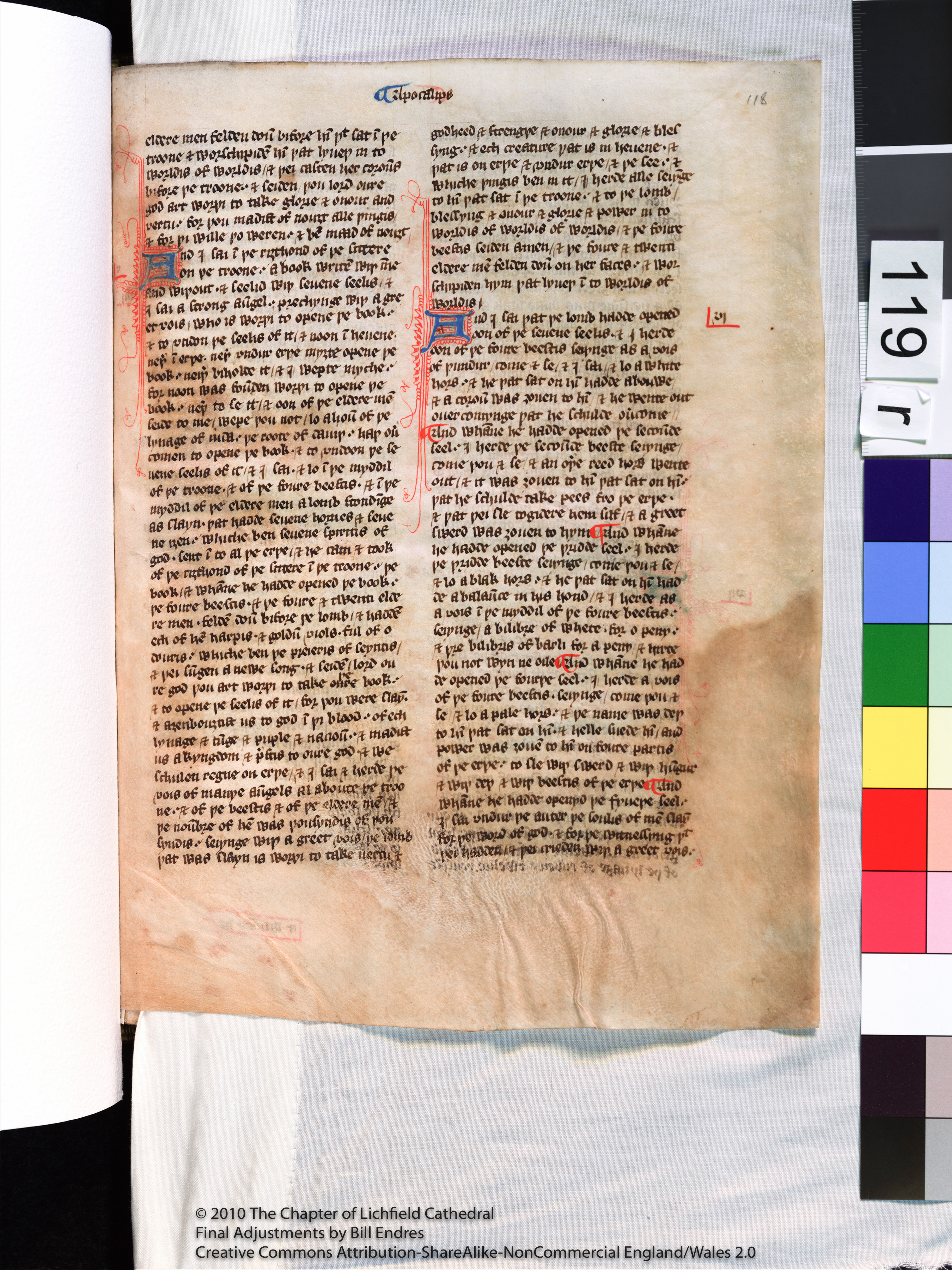
- c. 1395, John Wycliffe, John Purvey [et al.], transl., Bible (Wycliffite Bible (later version), MS Lich 10.)[2], published c. 1410, Apocalips 6:8, page 119r, column 1; republished as Wycliffe's translation of the New Testament, Lichfield: Bill Endres, 2010:
- ⁊ lo a pale hoꝛs .· and þe name was deþ to him þat ſat on hym and helle ſuede him / and power was ȝouen to him on foure partis of þe erþe .· to ſle with ſwerd / ⁊ wiþ hungur / ⁊ wiþ deþ / ⁊ wiþ beeſtis of þe erþe
- And lo! A pale horse, and the name was Death for who that sat on him, and hell trailed him. And power was given to him over four parts of the earth, to slay with sword, and with hunger, and with death, and with the earth's creatures.
- (rare) A horseman; a mounted soldier.
- (rare) A means of transport (analogous to a horse)
Related terms
Descendants
References
- “hors, n.”, in MED Online, Ann Arbor, Mich.: University of Michigan, 2007.
Etymology 2
Adjective
hors
- alternative form of hos
Norman
Etymology
From Old French fors, hors, from Latin foris, or back-derived from dehors, from Late Latin dē forīs.
Adverb
hors
Norwegian Nynorsk
Etymology
From Old Norse hors, metathesis of hross, from Proto-Germanic *hrussą. Akin to English horse.
Noun
hors n (definite singular horset, indefinite plural hors, definite plural horsa)
Derived terms
References
- “hors” in The Nynorsk Dictionary.
Old English
Etymology
From Proto-West Germanic *hross, from Proto-Germanic *hrussą (“horse”), from Proto-Indo-European *ḱers- (“to run”).
Pronunciation
- IPA(key): /xors/, [horˠs]
Noun
hors n
Declension
Strong a-stem:
| singular | plural | |
|---|---|---|
| nominative | hors | hors |
| accusative | hors | hors |
| genitive | horses | horsa |
| dative | horse | horsum |
Synonyms
Hyponyms
Derived terms
- horscamb (“horsecomb”)
- horshierde (“groom”)
- horselene (“elecampane”)
- horshwæl (“walrus”)
- horsminte (“horsemint”)
Descendants
Old French
Etymology
Derived from dehors, defors. See fors.
Adverb
hors
- (rare or Late Old French) from; out (of)
- c. 1180, Chrétien de Troyes, Perceval ou le conte du Graal:
- Puis errerent tant que il virent
gent qui hors del chastel issirent.- They walked until they saw
People coming out of the castle.
- They walked until they saw
Synonyms
Descendants
Old Frisian
Alternative forms
Etymology
From Proto-West Germanic *hross, from Proto-Germanic *hursą, *hrussą.
Noun
hors n
Inflection
| singular | plural | |
|---|---|---|
| nominative | hors | hors |
| accusative | hors | hors |
| genitive | horses | horsa |
| dative | horse | horsum, horsem |
Descendants
- North Frisian: hors
- ⇒ Saterland Frisian: rosje, rösje (“to groom (a horse)”, verb)
- West Frisian: hoars; rosje (“to groom (a horse)”, verb)
Old Norse
Noun
hors n
- alternative form of hross
Declension
| neuter | singular | plural | ||
|---|---|---|---|---|
| indefinite | definite | indefinite | definite | |
| nominative | hors | horsit | hors | horsin |
| accusative | hors | horsit | hors | horsin |
| dative | horsi | horsinu | horsum | horsunum |
| genitive | hors | horsins | horsa | horsanna |
Declension
Further reading
- Zoëga, Geir T. (1910), “hors”, in A Concise Dictionary of Old Icelandic, Oxford: Clarendon Press; also available at the Internet Archive
Serbo-Croatian
Etymology
Noun
hors m inan (Cyrillic spelling хорс)
- (slang) heroin
Declension
Swedish
Noun
hors
- indefinite genitive singular of hor