șușta
See also: susta
Romanian
Alternative forms
Etymology
Inherited from Latin suscitāre.[1]
Pronunciation
- IPA(key): /ʃuʃˈta/
- Rhymes: -a
- Hyphenation: șuș‧ta
Verb
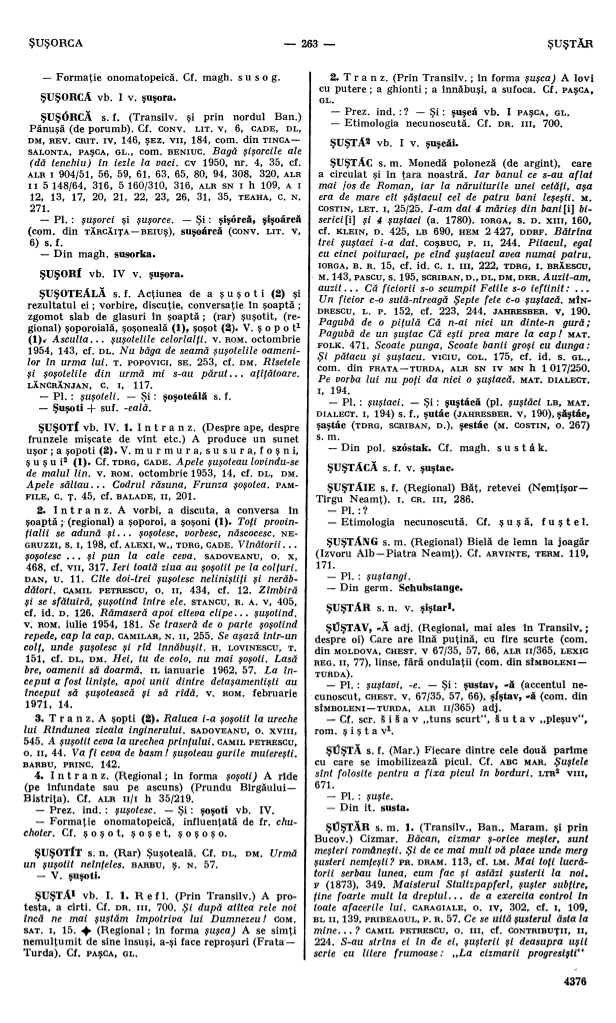
a șușta (third-person singular present not attested, past participle șuștat, third-person subjunctive not attested) 1st conjugation (Transylvania)
- (reflexive) to protest, complain[2] [with împotriva ‘against’]
- (reflexive) to be frustrated with oneself[3]
- (transitive) to knock the wind out of someone[3]
References
- ^ Nicolae Drăganu (1923), Dacoromania, year 3, Cluj, page 701
- ^ Traian German (1923), “O samă de cuvinte [A host of words]”, in Comoara Satelor [Treasure of the villages] (in Romanian), year 1, number 1, Blaj, page 15:
- A se șușta = a se răsvrăti, a cârti în potriva cuiva
„Și după atâtea rele noi încă ne mai șuștăm în potriva lui Dumnezeu!“ ¹)
¹) Auzit dela Lica Negruș în etate de 70 de ani în Sâmbotelec jud. Cojocna.- A se șușta = to rebel, to grumble against someone.
“And after so many hardships we still protest against God!” ¹)
¹) Heard from Lica Negruș aged 70 in Sâmbotelec (now Sâmboleni, Cămărașu commune, Cluj County).
- A se șușta = to rebel, to grumble against someone.
- ↑ 3.0 3.1 Ștefan Pașca (1928), “Glosar dialectal [Dialectal glossary]”, in Analele Academiei Române—Memoriile secțiunii literare [Annals of the Romanian Academy—Memoirs of the literary section] (in Romanian), series 3, tome 4, Bucharest: Cultura Națională, page 248: “șușcà, vb. trans. I. A sufocà, a înăbușì, a lovì cu putere cu pumnul, a ghiotì. I. Sohorca, Sângeorz-Băi și Șt. Pașca Crișcior. Refl: A se năcăjì pe sine însuși, a se «ciudălì». V. Bucur, Frata. ― șușca, transitive verb. I. To throttle, strangle, punch powerfully with the fist, to shove. Informants: Ion Sohorca, Sângeorz-Băi, Bistrița-Năsăud County and Ștefan Pașca, Crișcior, Hunedoara County. Reflexive: To frustrate oneself, to scowl. Informant: V. Bucur, Frata, Cluj County.”
Further reading
- “șușta”, in DEX online—Dicționare ale limbii române (Dictionaries of the Romanian language) (in Romanian), 2004–2025
- Iorgu Iordan, Alexandru Graur, Ion Coteanu, editors (1986), Dicționarul Limbii Române[1], volume 11, part 1, Bucharest: Academy of the Socialist Republic of Romania, page 263