| EMG |
|---|
|
Probability density function |
|
Cumulative distribution function |
| Parameters |
μ ∈ R — mean of Gaussian component
σ2 > 0 — variance of Gaussian component
λ > 0 — rate of exponential component |
|---|
| Support |
x ∈ R |
|---|
| PDF |
![{\displaystyle {\frac {\lambda }{2}}\exp \left[{\frac {\lambda }{2}}(2\mu +\lambda \sigma ^{2}-2x)\right]\operatorname {erfc} \left({\frac {\mu +\lambda \sigma ^{2}-x}{{\sqrt {2}}\sigma }}\right)}](./5e1a3fd847e9a021c38a3bf86630607608c7b703.svg) |
|---|
| CDF |
![{\displaystyle \Phi (x,\mu ,\sigma )-{\frac {1}{2}}\exp \left[{\frac {\lambda }{2}}(2\mu +\lambda \sigma ^{2}-2x)\right]\operatorname {erfc} \left({\frac {\mu +\lambda \sigma ^{2}-x}{{\sqrt {2}}\sigma }}\right)}](./132116643f9f9ca239cd804551cd3d1448354f2b.svg)
where
 is the CDF of a Gaussian distribution is the CDF of a Gaussian distribution |
|---|
| Mean |
 |
|---|
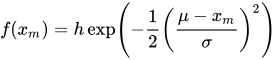
| Mode |

 |
|---|
| Variance |
 |
|---|
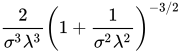
| Skewness |
 |
|---|
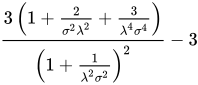
| Excess kurtosis |
 |
|---|
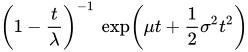
| MGF |
 |
|---|
| CF |
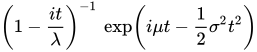 |
|---|
In probability theory, an exponentially modified Gaussian distribution (EMG, also known as exGaussian distribution) describes the sum of independent normal and exponential random variables. An exGaussian random variable Z may be expressed as Z = X + Y, where X and Y are independent, X is Gaussian with mean μ and variance σ2, and Y is exponential of rate λ. It has a characteristic positive skew from the exponential component.
It may also be regarded as a weighted function of a shifted exponential with the weight being a function of the normal distribution.

