Monotonicity criterion
The monotonicity criterion is quite intuitive: if the derivative of a function (i.e. the slope) is positive, it goes up, if the derivative is negative, it goes down. Mathematically, if the derivative  of a differentiable function
  is non-negative or (non-positive) on an interval
  , then is monotonically increasing (or decreasing) on . If is even strictly positive (or negative) , then is strictly monotonically increasing (or decreasing).
In the first case, even inversion of the statement is true: If a differentiable function is monotonically increasing on ![{\displaystyle [a,b]}](../_assets_/eb734a37dd21ce173a46342d1cc64c92/9c4b788fc5c637e26ee98b45f89a5c08c85f7935.svg) , then
, then  and if the function is monotonically decreasing on , then then . However, the inversion does not hold true in the strict case, monotone functions do not always have
  or
or  . For instance,
  is strictly monotone, but
  .
.
Theorem (Monotonicity criterion for differentiable functions)
Let ![{\displaystyle f:[a,b]\to \mathbb {R} }](../_assets_/eb734a37dd21ce173a46342d1cc64c92/b592d102ccd1ba134d401c5b3ea177baaba3ffac.svg) be continuous and differentiable on . Then, there is
be continuous and differentiable on . Then, there is
 on
on  monotonically increasing on
  on monotonically decreasing on
  on
on  strictly monotonically increasing on
  on strictly monotonically decreasing on
Proof
The four directions "" follow from the mean value theorem. The two directions " " follow by differentiability of the function:
Proof (monotonicity criterion for differentiable functions)
We first show the four directions "" and then the two "".
1. : From on we get that in monotonically increasing on .
Let for all  and let
 ![{\displaystyle x_{1},x_{2}\in [a,b]}](../_assets_/eb734a37dd21ce173a46342d1cc64c92/72d1bc3ddd05cec7229b2882cc0a74f4b3388514.svg) with
with  . We need to show
 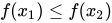 . By assumption, is continuous on
 ![{\displaystyle [x_{1},x_{2}]\subseteq [a,b]}](../_assets_/eb734a37dd21ce173a46342d1cc64c92/69880422c5f595a150ec38fa489615c9386222b9.svg) and differentiable on
and differentiable on  . By the mean-value theorem, there is a
  with
with
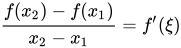
By assumption,  , and hence
 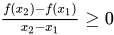 . Since
  we have in the enumerator
  . This is equivalent to
 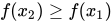 , i.e. is monotonically increasing.
2. : From on we get that in monotonically decreasing on .
Let for all and let with . We need to show 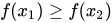 . By assumption, is continuous on and differentiable on . By the mean-value theorem, there is a with
Now,  , and hence . Since we have
  . This is equivalent to
 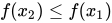 , i.e. is monotonically decreasing.
3. : on implies that is strictly monotonically increasing on
We prove this by contradiction: Let be not strictly monotonically increasing. That means, we have some with  and . We need to find a
  with . Now, is continuous on
 ![{\displaystyle [x_{1},x_{2}]}](../_assets_/eb734a37dd21ce173a46342d1cc64c92/91bdff343d848c2b70c68b5c04a2479b14a9fef0.svg) and differentiable on
and differentiable on  . So by the mean value theorem, we can find a with
Since , the enumerator of the quotient is non-positive, and because of the denominator is positive. Thus the whole fraction is non-positive, and therefore .
4. : on implies that is strictly monotonically increasing on
Another proof by contradiction: Let be not strictly monotonically decreasing. That means, we have some with and . We need to find a with . Now, is continuous on and differentiable on . So by the mean value theorem, we can find a with
Since , the enumerator of the quotient is non-positive, and because of the denominator is positive. Thus the whole fraction is non-positive, and therefore .
Now, the two directions "" follow:
1. : being monotonically increasing on implies on
Let with . By monotonicity, . Further, let ![{\displaystyle x,{\tilde {x}}\in [x_{1},x_{2}]}](../_assets_/eb734a37dd21ce173a46342d1cc64c92/38bbb3e2079dfd61a6074eea5ccf5ed248eb5130.svg) with
with  . Then we have for the difference quotient
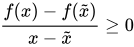
If  , then
  . The enumerator and denominator of the difference quotient are thus non-negative, and so is the total quotient. Similarly in the case of
  and
and  enumerator and denominator are non-positive. Thus the whole fraction is again non-negative. Now we form the differential quotient by taking the limit
  . This limit exists because is differentiable on . Furthermore, the inequality remains valid because of the monotonicity rule for limit values. Thus we have
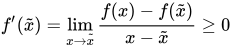
Since and  have been arbitrary, we get on all of .
2. : being monotonically decreasing on implies on
Let again with . By monotonicity, . Further, let with . Then we have for the difference quotient
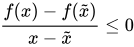
If , then and thus the total quotient is non-positive. An analogous statement holds in the case and . By forming the differential quotient we now obtain
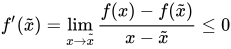
Since  and
and  have been arbitrary, we get on all of .
Examples: monotonicity criterion
Quadratic and cubic functions
Example (Monotonicity of quadratic and cubic functions)
For the quadratic power function  there is
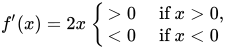
So is strictly monotonically decreasing by the monotonicity criterion on ![{\displaystyle (-\infty ,0]}](../_assets_/eb734a37dd21ce173a46342d1cc64c92/0241c015ef4c611c9c9aeafb395e7c4a16178405.svg) and strictly monotonically increasing on
and strictly monotonically increasing on  .
.
For the cubic power function  there is

So by the monotonicity criterion,  is monotonically increasing on
  and strictly monotonically increasing on and . The cubic power function
  is even strictly monotonically increasing on all of .
The fact that with is strictly monotonically increasing, although only and not , stems from its derivative being zero at only a single point (namely 0). In the end of this article, we will treat a criterion, which tells us when a function is strictly monotone, even if there is not everywhere .
Question: Why is
 strictly
 monotonically increasing on
?
Exponential and logarithm function
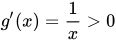
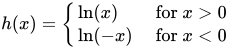
Question: What is the monotonicity behaviour of the logarithm function extended to

, i.e.

?
Trigonometric functions
Example (Monotonicity of the sine function)
For the sine function  there is

So for all  , the
, the  is strictly monotonically increasing on the intervals
 ![{\displaystyle [-{\tfrac {\pi }{2}}+2\pi k,{\tfrac {\pi }{2}}+2\pi k]}](../_assets_/eb734a37dd21ce173a46342d1cc64c92/9e821b04dddbb8b9f31022fade910d7ad6ca72c3.svg) and strictly monotonically decreasing on the intervals
and strictly monotonically decreasing on the intervals ![{\displaystyle [{\tfrac {\pi }{2}}+2\pi k,{\tfrac {3\pi }{2}}+2\pi k]}](../_assets_/eb734a37dd21ce173a46342d1cc64c92/d9626001227dbab3992b872c18767814b533b43e.svg) .
.
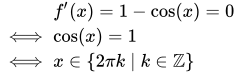
Question: Where does the cosine function

show monotone behaviour?
Here,  .
.
So for all , the  is strictly monotonically increasing on the intervals
 ![{\displaystyle [\pi +2\pi k,2\pi +2\pi k]}](../_assets_/eb734a37dd21ce173a46342d1cc64c92/44eb2f7b759357f5b69c28b67fd8cd49d7195a36.svg) and strictly monotonically decreasing on the intervals
and strictly monotonically decreasing on the intervals ![{\displaystyle [2\pi k,\pi +2\pi k]}](../_assets_/eb734a37dd21ce173a46342d1cc64c92/5deae55714ade73acbb4652ee1a9afa37f5e4c29.svg) .
.
Example (Monotonicity of the tangent function)
For the tangent function  there is for all
  :
:
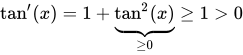
Hence, for all , the  is strictly monotonically increasing on the intervals
  .
.
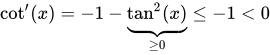
Question: Where does the cotangent function

show monotone behaviour?
Exercise
Monotonicity intervals and existence of a zero
Exercise (Monotonicity intervals and existence of a zero)
Where is the following polynomial function monotone?

Prove that has exactly one zero.
Solution (Monotonicity intervals and existence of a zero)
Monotonicity intervals:
The function is differentiable on all of , with

So

According to the monotonicity criterion, is strictly monotonically increasing on 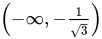 and on
  . Further,

According to the monotonicity criterion, is strictly monotonically decreasing on  .
.
has exactly one zero:
For , we have the following table of values:

Based on the monotonicity properties and the continuity of that we have previously investigated, we can read off that:
- On is strictly monotonically increasing. Because of
 there is
  for all
 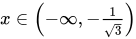 .
.
- On is then strictly monotonically decreasing. So there is also for all
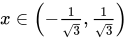 .
.
- Subsequently increases on again strictly monotonically. Because of
 and
and 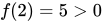 , there must be an
  with
with  by the mean value theorem. Because of the strict monotonicity of on , there cannot be any further zeros.
Necessary and sufficient criterion for strict monotonicity
Proof (Necessary and sufficient criterion for strict monotonicity)
From the monotonicity criterion we already know that is monotonically increasing exactly when . So we only have to show that is strictly monotonically increasing exactly when the second condition is additionally fulfilled.
: strictly monotonically increasing the set of zeros of does not contain an open interval.
We perform a proof by contradiction. In other words, we show: If the set of zeros of contains an open interval, is not strictly monotonically increasing. Assume there is 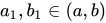 with
with  for all
  . Then, by the mean value theorem there is a
  with
with

So 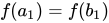 . If now
  , then since is monotonically increasing, there is

So there is 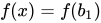 for all . Hence, is not strictly monotonically increasing.
: the set of zeros of does not contain an open interval strictly monotonically increasing
We perform a proof by contradiction. In other words, we show: if is monotonically, but not strictly monotonically increasing, then the zero set of contains an open interval. Assume there is 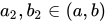 with
with  with
with 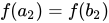 . Because of the monotonicity of there is

So 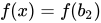 for all . That means is constant on
  . Hence there is for all
  :
:
so the set of zeros of does contain an open interval and we get a contradiction.
Exercise:  is strictly monotonically increasing