"A function is constant, if its derivative vanishes", i.e.  . This is the main statement which we want to make concrete in this article.
Criterion for constant functions
Identity theorem of differential calculus
The first conclusion of  implying that a function is constant is that functions with identical derivatives are identical except for one constant. This result will prove very useful later on in the fundamental theorem of calculus.
Proof (Identity theorem)
We define the auxiliary function
![{\displaystyle h:[a,b]\to \mathbb {R} ,\ h(x)=f(x)-g(x)}](../_assets_/eb734a37dd21ce173a46342d1cc64c92/c65ed4e7ee210fec2e0a8163fd4fc86c5eb443ec.svg)
This function is differentiables ince  and
and  are differentiable and

Hence, there must be  for all
 ![{\displaystyle x\in [a,b]}](../_assets_/eb734a37dd21ce173a46342d1cc64c92/026357b404ee584c475579fb2302a4e9881b8cce.svg) with a constant number
with a constant number  . Or equivalently,

Application: characterization of the exponential function
Proof (Characterization of the exponential function)
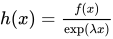
We define the auxiliary function

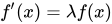
By the product and the chain rule, it is differentiable. There is

According to the criterion for a function being constant there is a with  for all . But this is now equivalent to

If now  and additionally
  , then

So  .
.
Exercises
Interval assumption for constant functions
The condition that the function is defined on an interval is necessary for the criterion for constancy! This is illustrated by the following task:
 must be chosen here such that it is not an interval. Otherwise it would follow from the previous sentence that is constant. So, let us take two intervals
Solution
We define  and set

The function is obviously not constant. But for all  there is
  .
.
For proving this we first consider a ![{\displaystyle {\tilde {x}}\in ]0,1[}](../_assets_/eb734a37dd21ce173a46342d1cc64c92/bb667d517da74ddae439e296ede05cb4d4f5bfd9.svg) . Let
. Let  be a sequence in
  which converges towards
  . Then there is an
  such that for all
  the inequality
 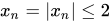 is fulfilled. From this we get
  . There is hence
 for all and
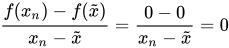
So:
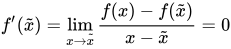
The proof that also for all  the equation is fulfilled goes completely analogous.
Trigonometric Pythagorean theorem
Using the criterion for constancy, identities of functions can also be proven very well:
Exercise (Trigonometric Pythagorean theorem)
Show that for all  there is

Here,  and
and  .
.
Solution (Trigonometric Pythagorean theorem)
We define the auxiliary function

According to the chain and sum rule for derivatives, this is differentiable on all of  , and there is

Thus  is a constant number
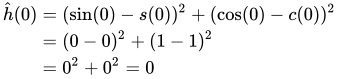
  . We can determine it by calculating
  :
:

So is constant  and there is:

Function equation for arctan
Exercise (Function equation for

)
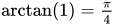
Show:  for
for 
Exercise: identity theorem
Exercise (Logarithm representation of the arsinh)
Show that for all there is

Proof (Logarithm representation of the arsinh)
The function  is differentiable on all of , see also the by the examples for derivatives. Its derivative is
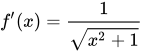
by the chain and sum rule, the function  is differentiable on all of . There is:
![{\displaystyle {\begin{aligned}g'(x)&={\frac {1}{x+{\sqrt {x^{2}+1}}}}\cdot \left(1+{\frac {2x}{2{\sqrt {x^{2}+1}}}}\right)\\[0.3em]&={\frac {1}{x+{\sqrt {x^{2}+1}}}}\cdot \left({\frac {{\sqrt {x^{2}+1}}+x}{\sqrt {x^{2}+1}}}\right)\\[0.3em]&={\frac {1}{\sqrt {x^{2}+1}}}\end{aligned}}}](../_assets_/eb734a37dd21ce173a46342d1cc64c92/3a2ca9d1da882c64822a9e1bc31b7ac44b42c82b.svg)
We have 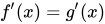 for all so by the identity theorem, with a constant . But now, since
  :
:

In addition

So  which implies the claim.
Characterization of sin and cos
Exercise (Characterization of sin and cos)
Let  be two differentiable functions with
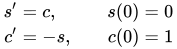
Prove that:
- There is
 for all
- There is exactly one pair of functions which meets the above conditions, namely
 and
and  .
.
Hint: Consider the help function in the second sub-task  .
.
Solution (Characterization of sin and cos)
Solution sub-exercise 1:
We consider the auxiliary function

where  and fulfil the conditions from above. Then
  is differentiable by the sum and chain rule, and
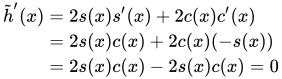
According to the criterion for constancy, there is  for some . We have

So  and we get the claim
  .
.


![{\displaystyle [a,b]}](../_assets_/eb734a37dd21ce173a46342d1cc64c92/9c4b788fc5c637e26ee98b45f89a5c08c85f7935.svg)


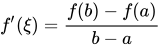
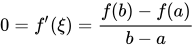





![{\displaystyle f,g:[a,b]\to \mathbb {R} }](../_assets_/eb734a37dd21ce173a46342d1cc64c92/e569de0fc730b7a75b46b6fd57598e0c94712f91.svg)









![{\displaystyle {\begin{aligned}f'(x)&={\frac {1}{1+x^{2}}}+{\frac {1}{1+{\frac {1}{x^{2}}}}}\cdot {\frac {-1}{x^{2}}}\\[0.5em]&={\frac {1}{1+x^{2}}}-{\frac {1}{1+x^{2}}}=0\end{aligned}}}](../_assets_/eb734a37dd21ce173a46342d1cc64c92/17a1679c16f91dba7eb08ff062b3ae9b80d9985b.svg)