Motivation
In the last chapter, we learned about convergence of sequences  . They were defined via the Epsilon-criterion, which says that
  must hold for all but finitely many
  . I.e. it holds for all
  with some
  . However, in order to apply this criterion, we need a candidate for the limit
  . What if we don't have such a candidate? Or more precisely,
A sequence converges, if the distance of to eventually tends to 0. In that case, also the difference between elements  tends to 0. Conversely, if we know that goes to 0 if both
  and
and  get large, then the amount of points where a possible limit or accumulation point might be shrinks together to a point. So the sequence should converge, then
The interesting question is now, what condition we have to put on and . If we just consider neighbouring sequence elements via setting  , we might run into trouble: consider the sequence

This is a harmonic series. The difference of neighbouring elements is  . But the sequence itself diverges to
  . We need a stronger criterion, i.e. we need to consider more pairs
  than just neighbours.
Derivation of Cauchy sequences
We try to get a condition on , which suffices for showing that a sequence converges. So let's take a sequence  converging to and play a bit with it: The epsilon-definition of convergence reads
 We fix
  . Then, there is an index
  depending on
  with
with  for all
  . What can we say about the difference for
  ? There is
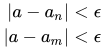
So the triangle inequality for implies:
![{\displaystyle {\begin{aligned}|a_{n}-a_{m}|&=|(a_{n}-a)+(a-a_{m})|\\[0.5em]&{\color {OliveGreen}\left\downarrow \ {\text{triangle inequality: }}|x+y|\leq |x|+|y|\right.}\\[0.5em]&\leq \underbrace {|a_{n}-a|} _{<\ \epsilon }+\underbrace {|a-a_{m}|} _{<\ \epsilon }\\&<2\epsilon \end{aligned}}}](../_assets_/eb734a37dd21ce173a46342d1cc64c92/1bc1672a36453a0af8f556ef2831bb62cac183d7.svg)
Sequence elements coming after  are all separated by less than
  . Visually, all sequence elements are all situated inside the interval
 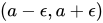 which has width :
The distance between two points in this interval is less than . So for a convergent sequence we have:

The  , in here is a bit awkward to most mathematicians. They remove it by defining
  . The function
  is mapping
  bijectively onto . So instead saying "for all ", we could also use the term "for all
  ":
":

Sequences, which fulfil the above property are called Cauchy sequences . This definition does not require a limit . A sequence which converges, fulfils the above property, so any convergent sequence is a Cauchy sequence. But seeing that any Cauchy sequence converges is not so easy. Generally, this is even wrong: Not every Cauchy sequence converges! However, it is true that every Cauchy sequence in  converges. In the rest this article , we successively construct a proof for this.
Hint
In the following section, we will again use instead of  .
.
Definition of a Cauchy sequence
The definition for a Cauchy sequence reads:
Intuitively, a sequence is Cauchy, if the difference between any two elements gets arbitrarily small as the element indices go to . Beware: it is a common mistake to think that only neighbouring elements must get close to each other. However, Cauchy sequences require all differences between elements to go to 0:
Example (A Cauchy sequence)
The sequence with  converges, so it should be a Cauchy sequence. We may also directly check the definition: for any , we need to find an , such that for all
  there is

We assume  . The case
  works analogously by interchanging and . Certainly,

Now, we take  such that
  (the Archimedean axiom allows us to do so). Then,
  and hence
  for all
  . So for all
  with
with  there is:

and we get that is a Cauchy sequence.
Every convergent sequence is a Cauchy sequence
We essentially already proved this within the "derivation of Cauchy sequences". But it's always a good idea, to write down one's findings in a structured way. So let's do this:
Theorem
Every convergent sequence is a Cauchy sequence.
How to get to the proof?
See "derivation of Cauchy sequences". The idea is to start with the -definition of convergence and to directly prove that the Cauchy condition with holds true. This will be the case for 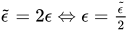 .
.
Proof
Let be any convergent sequence and be given. Then, there is an with
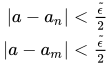
for all . Let now be arbitrary. Then,
![{\displaystyle {\begin{aligned}|a_{n}-a_{m}|&=|(a_{n}-a)+(a-a_{m})|\\[0.5em]&{\color {OliveGreen}\left\downarrow \ {\text{triangle inequality: }}|x+y|\leq |x|+|y|\right.}\\[0.5em]&\leq \underbrace {|a_{n}-a|} _{<\ {\tfrac {\epsilon }{2}}}+\underbrace {|a-a_{m}|} _{<\ {\tfrac {\epsilon }{2}}}<\epsilon \end{aligned}}}](../_assets_/eb734a37dd21ce173a46342d1cc64c92/4abeba6ddc155d0537ec3dcce634382893b040e9.svg)
Cauchy sequences are bounded
Convergent series are bounded. And we can prove the same for Cauchy sequences:
Theorem (Cauchy sequences are bounded)
Any Cauchy sequence is bounded.
Proof (Cauchy sequences are bounded)
Let be a Cauchy sequence. We know that for any there is an with 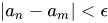 for all . Now, we just fix
  (actually, any positive real number is OK, here) and get some with
 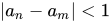 for all . Now, we fix
  and get
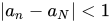
for all . So all with are "caught" inside the interval  . That means, after passing index , all sequence elements are bounded from above by
  and from below by
  :
:

Only the sequence elements before  remain. But those are finitely many, namely
  . A finite set of numbers is always bounded. So these "early sequence elements" are bounded from above by
  and from below by
  . For the entire sequence, there is

So the sequence is bounded from above by  and from below by
  .
.
Cauchy sequences with convergent subsequences also converge
We would like to show that in , a Cauchy sequence converges. This is a somewhat longer task. So we first take a smaller step and prove the following smaller theorem:
How to get to the proof? (Cauchy sequences with convergent subsequences also converge)
Let be a Cauchy sequence and  a subsequence converging to . For , the difference gets very small and for the convergent subsequence, the elements tend to . The idea is not to fix an element
  from the subsequence, which is close to and catch all after it by the Cauchy condition.
How close do we need to get? Suppose, is given. We need to find some such that for all . So the target inequality is
If is an element of the subsequence , this is not a problem. We could even get 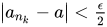 or smaller. And if is not part of the convergent subsequence? Then, we need to use the Cauchy-property. If we choose large enough, there will be elements
  of the subsequence with
  . So we can bound
  using the triangle inequality:
![{\displaystyle {\begin{aligned}|a_{n}-a|&=\left|a_{n}-a_{n_{k}}+a_{n_{k}}-a\right|\\[0.5em]&{\color {OliveGreen}\left\downarrow \ {\text{triangle inequality}}\right.}\\[0.5em]&\leq \left|a_{n}-a_{n_{k}}\right|+\left|a_{n_{k}}-a\right|\end{aligned}}}](../_assets_/eb734a37dd21ce173a46342d1cc64c92/38c578301f2f41d7454e192480032abd8fbd1649.svg)
Both absolutes can be made arbitrarily small. Their sum must be smaller than . This is fulfilled if we choose both absolutes to be smaller than  . sIn order to get
  that small, we choose some
  with for all
  . Such an exists, as converges to .
Now the second absolute value: By the Cauchy sequence property, there must be some  with
with 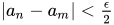 for all
  . In place of , we choose . So we need
  . We know that
  , since
  is an ascending number of positive integers. Therefore, we add the requirement
  , which implies
  . If we now set
  . Note: any will do that job, no matter how big.
So far, the variable only appeared within . Here, we required . So for , there is only one condition:  . We satisfy it by choosing
  . Now, we are ready to write down the proof.
Every Cauchy sequence converges
Now, that we have the smaller theorem above, we can use it to show the final theorem:
Theorem (Every Cauchy sequence converges)
Let be a real Cauchy sequence. Then, converges to some  .
.
This theorem is of particularly high value, since it allows to show convergence of a sequence without having a candidate for a limit.
Before proving it, we will stress out that there are sets where not every Cauchy sequence converges. For instance, we might want to replace the condition by  (rational numbers). However, there are some possible limits, which are in , but not in
  . For instance, take
  , which is the limit of the rational sequence
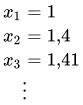
in , this sequence converges to  . So it is a Cauchy sequence . Since the Cauchy condition is sustained under the replacement
  , this is also a Cauchy sequence in . However, in , the limit
  is unique, so there cannot be a further limit . Hence, we have found a Cauchy sequence, which does not converge.
We conclude, there are sets like , where Cauchy sequences may not converge. The crucial point her is that is complete, while is not. We have already encountered completeness within the Bolzano-Weierstrass theorem, where it was necessary for the theorem to hold true. Similarly, completeness is also necessary for a Cauchy sequence to converge.
is unique, so there cannot be a further limit . Hence, we have found a Cauchy sequence, which does not converge.
We conclude, there are sets like , where Cauchy sequences may not converge. The crucial point her is that is complete, while is not. We have already encountered completeness within the Bolzano-Weierstrass theorem, where it was necessary for the theorem to hold true. Similarly, completeness is also necessary for a Cauchy sequence to converge.

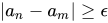






![{\displaystyle {\begin{aligned}|a_{n}-a|&=\left|a_{n}-a_{n_{\tilde {k}}}+a_{n_{\tilde {k}}}-a\right|\\[0.5em]&{\color {OliveGreen}\left\downarrow \ {\text{triangle inequality}}\right.}\\[0.5em]&\leq \left|a_{n}-a_{n_{\tilde {k}}}\right|+\left|a_{n_{\tilde {k}}}-a\right|\\[0.5em]&{\color {OliveGreen}\left\downarrow \ \left|a_{n_{\tilde {k}}}-a\right|<{\tfrac {\epsilon }{2}}\right.}\\[0.5em]&<\left|a_{n}-a_{n_{\tilde {k}}}\right|+{\tfrac {\epsilon }{2}}\\[0.5em]&{\color {OliveGreen}\left\downarrow \ n_{k}\geq {\tilde {k}}\geq N\Rightarrow \left|a_{n}-a_{n_{\tilde {k}}}\right|<{\tfrac {\epsilon }{2}}\right.}\\[0.5em]&<{\tfrac {\epsilon }{2}}+{\tfrac {\epsilon }{2}}=\epsilon \end{aligned}}}](../_assets_/eb734a37dd21ce173a46342d1cc64c92/8a5631d4d4d9e2eaa7a1a0688be111adb9f91095.svg)