Fehler: Aktuelle Seite wurde in der Sitemap nicht gefunden. Deswegen kann keine Navigation angezeigt werden
Linear maps are special maps between vector spaces that are compatible with the vector space structure. They are one of the most important concepts of linear algebra and have numerous applications in science and technology.
Motivation
What makes linear maps special
We have learned about the structure of vector spaces and studied various properties of them. Now we want to consider not only isolated vector spaces, but also maps between them. Some of these maps fit well with the underlying vector space structure and are therefore called linear maps or vector space homomorphisms. They are a generalization of linear functions through the origin in one dimension, whose graphs are lines (hence the name).
It is a typical approach in algebra to study maps that preserve the structure of an algebraic object, such as a vector space. For many algebraic objects such as groups, rings or fields, one often studies the corresponding structure-preserving maps between the respective algebraic structures - group homomorphisms, ring homomorphisms and field homomorphisms. For vector spaces, the structure-preserving maps are the linear maps (= vector space homomorphisms).
So let  and
and  be two vector spaces. When is a map
  structure-preserving or well compatible with the underlying vector space structures in and ? For this, let's repeat what the vector space structure is all about: They basically allow for two operations:
- Addition of vectors: two vectors can be added, in a similar way to how numbers are added.
- Scalar multiplication: vectors with a scaling factor (which is an element of the field) can be scaled. That means: compressed, stretched or mirrored.
Compatibility with addition
Let's start with of addition of vectors: when is a function compatible with the additions  and
and  on the respective vector spaces and ? The most natural definition is the following:
Thus, a map compatible with addition satisfies for all  the implication:

This implication can be summarized in one equation by substituting the premise  into the second equation. It thus suffices to require for all
  that:
that:

This equation describes the first characteristic property of the linear map, namely "being compatible with vector addition". We can visualize it well for maps  . A map is compatible with addition if and only if the triangle given by the vectors
  ,
,  and is preserved under applying the map. That means, also the three vectors
  ,
,  and
and  hive to form a triangle:
If  is not compatible with addition, there are vectors and with
  . The triangle generated by , and is then not preserved, because the triangle side
  of the initial triangle is not mapped to the triangle side
  in the target space:
Compatibility with scalar multiplication
Analogously, we can naturally define that a map is compatible with scalar multiplication if and only if it is preserved by the map. So it should hold for all  and for all scalars
  that
that

Note that  is a scalar and not a vector and thus is not changed by the map under consideration. In other words, it can be "pulled out of the bracket". This move is only allowed if both vector spaces have the same underlying field. Both the domain of definition and the range of values must be vector spaces over the same
  .
.
Linear maps thus preserve scalings. From  one may conclude
 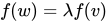 . For the case where
  , straight lines of the form
 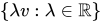 are mapped to the straight line
  . The above implication can be summarized in an equation. For all
  and , we require that:

For maps this means that a scaled vector  is mapped to the correspondingly scaled version
  of the image vector:
If a map is not compatible with scalar multiplication, there is a vector  and a scaling factor such that
  :
:
Recap
A linear map is a special map between vector spaces that is compatible with the structure of the underlying vector spaces. In particular, this means that a linear map has the following two characteristic properties:
- compatibility with addition:
 .
.
- compatibility with scalar multiplication:

The compatibility with addition is called additivity and the compatibility with scalar multiplication is called homogeneity.
Definition
Hint
In the literature, the term vector space homomorphism or homomorphism for short is also used as a synonym for the term linear map. The ancient Greek word homós stands for equal, morphé stands for shape. Literally translated, a vector space homomorphism is a map between vector spaces, which leaves the "shape" of the vector spaces invariant.
Explanation of the definition
The characteristic equations of the linear map are  and
and  . What do these two properties intuitively mean? According to the additivity property, it doesn't matter whether you first add and and then map them, or whether you first map both vectors and then add them. Both ways lead to the same result:
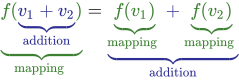
What does the homogeneity property mean? Regardless of whether you first scale by and then map it or first map the vector and then scale it by , the result is the same:
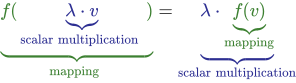
The characteristic properties of linear maps mean that the orders of function mapping and vector space operations do not matter.
Charakterization: linear combinations are mapped to linear combinations
Besides the defining property that linear maps get along well with the underlying vector space structure, linear maps can also be characterized by the following property:
.
This is an important property because linear combinations are used to define important structures on vector spaces such as the linear independence or having generators. Also the definition of the basis relies on the notion of linear combination. The connection to linear combinations can be seen by looking at the two characteristic equations of linear maps:
![{\displaystyle {\begin{aligned}f(v_{1}+v_{2})&=f(v_{1})+f(v_{2})\\[0.5em]f(\lambda \cdot v)&=\lambda \cdot f(v)\end{aligned}}}](./_assets_/eb734a37dd21ce173a46342d1cc64c92/e7d954b4b0d4892e406c13a1c52e9515ba5610f7.svg)
We can apply the two formulas above step-by-step to a linear combination like  for vectors
  and
and  from . This allows us to "get the linear combination out of the bracket":
![{\displaystyle {\begin{aligned}&f(3\cdot u+5\cdot w-2\cdot z)\\[0.3em]&{\color {OliveGreen}\left\downarrow \ {\text{additivity of }}f\right.}\\[0.3em]=&f(3\cdot u)+f(5\cdot w-2\cdot z)\\[0.3em]&{\color {OliveGreen}\left\downarrow \ {\text{additivity of }}f\right.}\\[0.3em]=&f(3\cdot u)+f(5\cdot w)+f(-2\cdot z)\\[0.3em]&{\color {OliveGreen}\left\downarrow \ {\text{homogeneity of }}f\right.}\\[0.3em]=&3\cdot f(u)+5\cdot f(w)-2\cdot f(z)\end{aligned}}}](./_assets_/eb734a37dd21ce173a46342d1cc64c92/d25786d40c648a7b699b7b0d7fcbd78b5c40df7b.svg)
The linear combination is mapped by to  and thus keeps its structure. The situation is similar for other linear combinations. For by the property sums "can be pulled out of the bracket" and by the property scalar multiplications "can be pulled out of the bracket". We thus obtain the following alternative characterization of the linear map: linear combinations are mapped to linear combinations.
Examples
Stretch in  -direction
Our first example is a stretch by the factor  in -direction in the plane
  . Here, every vector
  is mapped to
  . The following figure shows this map for
  . The
. The  -coordinate remains the same and the -coordinate is doubled:
Now let's see if this map is compatible with addition. So let's take two vectors  and
and  , sum them
  and then stretch them in -direction. The result is the same as if we first stretch both vectors in -direction and then add them:
This can also be shown mathematically. Our map is the function  . We can now check the property
  :
:
![{\displaystyle {\begin{aligned}f(a+b)&=f\left({\begin{pmatrix}a_{x}\\a_{y}\end{pmatrix}}+{\begin{pmatrix}b_{x}\\b_{y}\end{pmatrix}}\right)\\[0.5em]&=f\left({\begin{pmatrix}a_{x}+b_{x}\\a_{y}+b_{y}\end{pmatrix}}\right)\\[0.5em]&={\begin{pmatrix}\beta (a_{x}+b_{x})\\a_{y}+b_{y}\end{pmatrix}}\\[0.5em]&={\begin{pmatrix}\beta a_{x}+\beta b_{x}\\a_{y}+b_{y}\end{pmatrix}}\\[0.5em]&={\begin{pmatrix}\beta a_{x}\\a_{y}\end{pmatrix}}+{\begin{pmatrix}\beta b_{x}\\b_{y}\end{pmatrix}}\\[0.5em]&=f\left({\begin{pmatrix}a_{x}\\a_{y}\end{pmatrix}}\right)+f\left({\begin{pmatrix}b_{x}\\b_{y}\end{pmatrix}}\right)\\[0.5em]&=f(a)+f(b)\\[1em]\end{aligned}}}](./_assets_/eb734a37dd21ce173a46342d1cc64c92/96845103ae00c2f8473d45ec6a9a717ae9e2da83.svg)
Now let's check the compatibility with scalar multiplication. The following figure shows that it doesn't matter if the vector is first scaled by a factor of and then stretched in -direction or first stretched in -direction and then scaled by :
This can also be shown formally: For  and
and  we have that
![{\displaystyle {\begin{aligned}f(\lambda a)&=f\left(\lambda {\begin{pmatrix}a_{x}\\a_{y}\end{pmatrix}}\right)=f\left({\begin{pmatrix}\lambda a_{x}\\\lambda a_{y}\end{pmatrix}}\right)\\[0.5em]&={\begin{pmatrix}\beta (\lambda a_{x})\\\lambda a_{y}\end{pmatrix}}={\begin{pmatrix}\lambda \beta a_{x}\\\lambda a_{y}\end{pmatrix}}\\[0.5em]&=\lambda {\begin{pmatrix}\beta a_{x}\\a_{y}\end{pmatrix}}=\lambda f\left({\begin{pmatrix}a_{x}\\a_{y}\end{pmatrix}}\right)\\[0.5em]&=\lambda f(a).\end{aligned}}}](./_assets_/eb734a37dd21ce173a46342d1cc64c92/b6967919226af395b651a7009ca9f3e24fd0d213.svg) So our is a linear map.
So our is a linear map.
Rotations
In the following, we consider a rotation  of the plane by the angle
  (measured counter-clockwise) with the origin as center of rotation. Thus, it is a map
 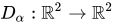 that assigns to every vector
  the vector rotated by the angle
  :
:
Let us now convince ourselves that is indeed a linear map. To do this, we need to show that:
- is additive: for all
 , we have
  .
.
- is homogeneous: For all
 and we have
  .
.
First, we check additivity, that is, the equation . If we add two vectors and then rotate their sum  by the angle , the same vector should come out, as if we first rotate the vectors by the angle and then add the rotated vectors
  and
and  . This can be visualized by the following two videos:
-
Rotate first, then add
-
Add first, then rotate
Now we come to homogeneity: . If we first stretch a vector by a factor and then rotate the result  by the angle , we should get the same vector as if we first rotate the by an angle and then scale the result by the factor . This is again visualized by two videos:
-
Rotate first, then scale
-
Scale first, then rotate
Thus, rotations in are indeed linear maps.
Linear maps between vector spaces of different dimension
An example of a linear map between two vector spaces with different dimensions is the following projection of the space  onto the plane :
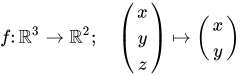
We now check whether the vector addition is preserved. That means, for vectors  we need that
This can be verified directly:
![{\displaystyle {\begin{aligned}f(a+b)&=f\left({\begin{pmatrix}a_{x}\\a_{y}\\a_{z}\end{pmatrix}}+{\begin{pmatrix}b_{x}\\b_{y}\\b_{z}\end{pmatrix}}\right)=f\left({\begin{pmatrix}a_{x}+b_{x}\\a_{y}+b_{y}\\a_{z}+b_{z}\end{pmatrix}}\right)\\[0.5em]&={\begin{pmatrix}a_{x}+b_{x}\\a_{y}+b_{y}\end{pmatrix}}={\begin{pmatrix}a_{x}\\a_{y}\end{pmatrix}}+{\begin{pmatrix}b_{x}\\b_{y}\end{pmatrix}}\\[0.5em]&=f\left({\begin{pmatrix}a_{x}\\a_{y}\\a_{z}\end{pmatrix}}\right)+f\left({\begin{pmatrix}b_{x}\\b_{y}\\b_{z}\end{pmatrix}}\right)=f(a)+f(b).\end{aligned}}}](./_assets_/eb734a37dd21ce173a46342d1cc64c92/f1e199c5cfe7500a63c033ca6be0b03e698950c8.svg)
Now we check homogeneity. For all and we need:

We have that
![{\displaystyle {\begin{aligned}f(\lambda \cdot a)&=f\left(\lambda \cdot {\begin{pmatrix}a_{x}\\a_{y}\\a_{z}\end{pmatrix}}\right)=f\left({\begin{pmatrix}\lambda a_{x}\\\lambda a_{y}\\\lambda a_{z}\end{pmatrix}}\right)\\[0.5em]&={\begin{pmatrix}\lambda a_{x}\\\lambda a_{y}\end{pmatrix}}=\lambda \cdot {\begin{pmatrix}a_{x}\\a_{y}\end{pmatrix}}=\lambda \cdot f\left({\begin{pmatrix}a_{x}\\a_{y}\\a_{z}\end{pmatrix}}\right)\\[0.5em]&=\lambda \cdot f(a).\end{aligned}}}](./_assets_/eb734a37dd21ce173a46342d1cc64c92/f2f33410ca7ea467debe286f98dc47857362030a.svg)
So the projection is a linear map.
A non-linear map
Next, we investigate some examples for non-linear maps. It is easy to come up with such maps: basically any function on  whose graph is not a line is a non-linear map. So "most maps are non-linear".
Of course, there are also examples for non-linear maps on . For instance, consider the norm mapping on the plane which assigns the length to every vector:

This map is not a linear map, because it does not preserve either vector addition or scalar multiplication.
We show this by a counterexample:
Consider the two vectors  and
and  . If we add the vectors first and map them (determine their length) afterwards, we get

Now we determine the lengths of the vectors first and then add the results:

Thus we have that

This shows that the norm mapping is not additive. Finding a contradiction to one property (either additivity or homogeneity) already proves that the normal mapping is not linear.
Alternatively, we could have shown that the norm mapping is not homogeneous:

Applied examples
Linear maps are used in almost all technological fields. Here is just a very tiny collection of some examples:
- In order to make predictions or control machines, complicated functions are often approximated by linear ones (regression). Mainly because linear maps are easy to handle.
- The best known case where linear maps make our lives easier are computer graphics. Any scaling of a photo or graphic is a linear map. Even different screen resolutions ended up being linear maps.
- Search engines use page ranks of a website to sort their search results. our "Serlo-page", also gets a ranking this way. To determine the page rank, a so-called Markov chain is used, which is a somewhat more sophisticated linear map.
Linear maps preserve structure
A linear map, also called vector space homomorphism, preserves the structure of the vector space. This is shown in the following properties of a linear mapping :
- The zero vector is mapped to the zero vector:
 .
.
- Inverses are mapped to inverses:
 .
.
- Linear combinations are mapped to linear combinations.
- Compositions of linear maps are again linear
- Images of subspaces are subspaces
- The image of a span is the span of the individual image vectors:
 (
( is supposed to be an arbitrary set)
Relation to linear functions and affine maps
Linear functions in one dimension take the form  with
with  . They are only linear maps in some cases, namely for
  . As an example, for
  and
and  :
:

Maps are in fact linear, if and only if , i.e., the map takes the form  with
with  . The functions of the form are called affine-linear maps or simply affine maps: They are the sum of a linear map and a constant translational term
  . Every linear map is affine-linear, but not the other way round!
However, affine maps still map straight lines to straight lines and preserve parallel lines and ratios of distances.
We can always decompose an affine map  into a linear map
  and a translation
  . We have that also
  . Because the translations are easy to describe, the linear part is usually more interesting. In the theory we therefore only look at the linear part.
Exercises
The identity is a linear map
Proof (The identity is a linear map)
The identity is additive: Let  , then.

The identity is homogeneous: Let and , then

The map to zero is a linear map
Proof (The map to zero is a linear map)
is additive: let  be vectors in . Then

is homogeneous: Let and let . Then

Thus, the map to zero is linear
Linear maps on the real numbers
Solution (Linear maps on the real numbers)
Let first  be a linear map. Since linear maps map the origin to the origin,
  must hold. Now
  and so must hold.
Let now . We show that  is linear:
Proof step: additivity
Let and be any two real numbers. We have that
![{\displaystyle {\begin{aligned}&g(x+y)\\[0.3em]&{\color {OliveGreen}\left\downarrow \ {\text{definition of }}g\right.}\\[0.3em]=&m\cdot (x+y)\\[0.3em]=&m\cdot x+m\cdot y\\[0.3em]&{\color {OliveGreen}\left\downarrow \ {\text{definition of }}g\right.}\\[0.3em]=&g(x)+g(y)\end{aligned}}}](./_assets_/eb734a37dd21ce173a46342d1cc64c92/37ab68ccb12d1a1f09f39651553ce42e04380bce.svg)
Proof step: homogeneity
Let and be two real numbers. We have that
![{\displaystyle {\begin{aligned}&g(\lambda \cdot x)\\[0.3em]&{\color {OliveGreen}\left\downarrow \ {\text{definition of }}g\right.}\\[0.3em]=&m\cdot (\lambda \cdot x)\\[0.3em]=&m\cdot \lambda \cdot x\\[0.3em]=&\lambda \cdot (m\cdot x)\\[0.3em]&{\color {OliveGreen}\left\downarrow \ {\text{definition of }}g\right.}\\[0.3em]=&\lambda \cdot g(x)\end{aligned}}}](./_assets_/eb734a37dd21ce173a46342d1cc64c92/e08c774f4037bff941a8c357df6da11a56e160d7.svg)
So is a linear map, if and only if .
Fehler: Aktuelle Seite wurde in der Sitemap nicht gefunden. Deswegen kann keine Navigation angezeigt werden














