Fehler: Aktuelle Seite wurde in der Sitemap nicht gefunden. Deswegen kann keine Navigation angezeigt werden
We have compiled some tasks on linear maps here. The proof structures can help you to solve other similar tasks.
As a reminder, here is the definition of a linear map:
Showing linearity of a mapping
Linear maps from  to
to 
Exercise (Linear map into a field)
Let  be defined by
  .
Show that the map
.
Show that the map  is linear.
How to get to the proof? (Linear map into a field)
First you have to show the additivity and then homogeneity of the map.
Solution (Linear map into a field)
Exercise (Linear map from

to

)
Show that the map  with
with 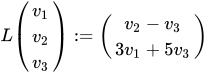 is linear.
Solution (Linear map from
to
)
Aktuelles Ziel: Additivity
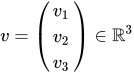
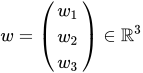
![{\displaystyle {\begin{aligned}L\left({\begin{pmatrix}v_{1}\\v_{2}\\v_{3}\end{pmatrix}}+{\begin{pmatrix}w_{1}\\w_{2}\\w_{3}\end{pmatrix}}\right)&=L{\begin{pmatrix}v_{1}+w_{1}\\v_{2}+w_{2}\\v_{3}+w_{3}\end{pmatrix}}\\[0.3em]&{\color {OliveGreen}\left\downarrow \ {\text{definition of }}L\right.}\\[0.3em]&=\ {\begin{pmatrix}(v_{2}+w_{2})-(v_{3}+w_{3})\\3(v_{1}+w_{1})+5(v_{3}+w_{3})\end{pmatrix}}\\[0.3em]&{\color {OliveGreen}\left\downarrow \ {\text{commutative, associative, distributive in }}\mathbb {R} \right.}\\[0.3em]&=\ {\begin{pmatrix}(v_{2}-v_{3})+(w_{2}-w_{3})\\(3v_{1}-5v_{3})+(3w_{1}-5w_{3})\end{pmatrix}}\\[0.3em]&=\ {\begin{pmatrix}(v_{2}-v_{3})\\(3v_{1}-5v_{3})\end{pmatrix}}+{\begin{pmatrix}(w_{2}-w_{3})\\(3w_{1}-5w_{3})\end{pmatrix}}\\[0.3em]&{\color {OliveGreen}\left\downarrow \ {\text{definition of }}L\right.}\\[0.3em]&=\ L{\begin{pmatrix}v_{1}\\v_{2}\\v_{3}\end{pmatrix}}+L{\begin{pmatrix}w_{1}\\w_{2}\\w_{3}\end{pmatrix}}\end{aligned}}}](./_assets_/eb734a37dd21ce173a46342d1cc64c92/5491124efb6c2f943b939a5f907936c48e41224a.svg)
Aktuelles Ziel: Scaling
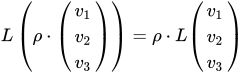
![{\displaystyle {\begin{aligned}L\left(\rho \cdot {\begin{pmatrix}v_{1}\\v_{2}\\v_{3}\end{pmatrix}}\right)&=L{\begin{pmatrix}\rho v_{1}\\\rho v_{2}\\\rho v_{3}\end{pmatrix}}\\[0.3em]&{\color {OliveGreen}\left\downarrow \ {\text{definition of }}L\right.}\\[0.3em]&=\ {\begin{pmatrix}\rho v_{2}-\rho v_{3}\\3(\rho v_{1})+5(\rho v_{3})\end{pmatrix}}\\[0.3em]&{\color {OliveGreen}\left\downarrow \ {\text{commutative, associative, distributive in }}\mathbb {R} \right.}\\[0.3em]&=\ {\begin{pmatrix}\rho (v_{2}-v_{3})\\(\rho (3v_{1}+5v_{3})\end{pmatrix}}\\[0.3em]&=\ \rho \cdot {\begin{pmatrix}(v_{2}-v_{3})\\(3v_{1}+5v_{3})\end{pmatrix}}\\[0.3em]&{\color {OliveGreen}\left\downarrow \ {\text{definition of }}L\right.}\\[0.3em]&=\ \rho \cdot L{\begin{pmatrix}v_{1}\\v_{2}\\v_{3}\end{pmatrix}}\end{aligned}}}](./_assets_/eb734a37dd21ce173a46342d1cc64c92/4af777507e34fde80dc3cc1ef4e36afa13b03210.svg)
Exercise (Linearity of the embedding)
Show that for  , the map
  is linear.
Solution (Linearity of the embedding)
Let  and
and  , as well as
  . By definition of the map , we have that
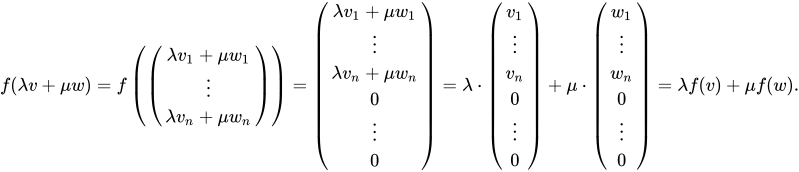
So is linear.
We consider an example for a linear map of to :
 with
with 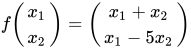
Exercise (Linearity of
)
Show that the map  is linear.
Proof (Linearity of
)
is an  -vector space. In addition, the map is well-defined.
Proof step: homogeneity
Let  and
and 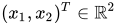 . Then:
![{\displaystyle {\begin{aligned}f\left(\lambda \cdot {\begin{pmatrix}x_{1}\\x_{2}\end{pmatrix}}\right)&=f{\begin{pmatrix}\lambda \cdot x_{1}\\\lambda \cdot x_{2}\end{pmatrix}}\\[0.3em]&{\color {OliveGreen}\left\downarrow \ {\text{definition of }}f\right.}\\[0.3em]&={\begin{pmatrix}\lambda x_{1}+\lambda x_{2}\\\lambda x_{1}-5\lambda x_{2}\end{pmatrix}}\\[0.3em]&{\color {OliveGreen}\left\downarrow \ {\text{distributive law}}\right.}\\[0.3em]&={\begin{pmatrix}\lambda (x_{1}+x_{2})\\\lambda (x_{1}-5x_{2})\end{pmatrix}}\\[0.3em]&{\color {OliveGreen}\left\downarrow \ {\text{scalar multiplication}}\right.}\\[0.3em]&=\lambda \cdot {\begin{pmatrix}(x_{1}+x_{2})\\(x_{1}-5x_{2})\end{pmatrix}}\\[0.3em]&{\color {OliveGreen}\left\downarrow \ {\text{definition of }}f\right.}\\[0.3em]&=\lambda \cdot f{\begin{pmatrix}x_{1}\\x_{2}\end{pmatrix}}\\[0.3em]\end{aligned}}}](./_assets_/eb734a37dd21ce173a46342d1cc64c92/fbcfaa67923713044f9dd485d620d298c954c283.svg)
Thus the map is linear.
Important special cases
Proof (The identity is a linear map)
The identity is additive: Let  , then.

The identity is homogeneous: Let  and
and  , then

Proof (The map to zero is a linear map)
is additive: let  be vectors in
  . Then

is homogeneous: Let and let . Then

Thus, the map to zero is linear
Linear maps between function spaces
Exercise (Mapping on a function space)
Consider the function space ![{\displaystyle \operatorname {Fun} ([0,1],\mathbb {R} )}](./_assets_/eb734a37dd21ce173a46342d1cc64c92/db301ca4d41cb192de90f301cce0d880388b7901.svg) of all functions from to , as well as the map
of all functions from to , as well as the map
![{\displaystyle {\begin{aligned}\phi \colon \operatorname {Fun} ([0,1],\mathbb {R} )&\to \mathbb {R} ,\\f&\mapsto f(0).\end{aligned}}}](./_assets_/eb734a37dd21ce173a46342d1cc64c92/0a09395fec62498487bc2b656b1e17251de0ffb6.svg) Show that
Show that  is linear.
Solution (Mapping on a function space)
The operations on the function space are defined element-wise in each case.
That means: for ![{\displaystyle f,g\in \operatorname {Fun} ([0,1],\mathbb {R} )}](./_assets_/eb734a37dd21ce173a46342d1cc64c92/d606223465adce9926f20a2385d0865e74813f7e.svg) , and
, and ![{\displaystyle x\in [0,1]}](./_assets_/eb734a37dd21ce173a46342d1cc64c92/64a15936df283add394ab909aa7a5e24e7fb6bb2.svg) we have that
we have that  and
and  .
In particular, this is true for
.
In particular, this is true for  , which implies
 and
and
 Thus, we have established linearity.
Exercise (The precomposition with a map is linear.)
Let be a vector space, let  be sets, and let
  or
or  be the vector space of functions from
  or
or  to . Let
  be arbitrary but fixed. We consider the mapping
 Show that
  is linear.
Proof (The precomposition with a map is linear.)
Let  .
.
Let  and .
and .
Now, additivity and homogeneity of implies that is a linear map.
Exercise (Sequence space)
Let be the -vector space of all real-valued sequences. Show that the map

is linear.
How to get to the proof? (Sequence space)
To show linearity, two properties need to be checked:
- is additive:
 for all
- is homogeneous:
 for all and
The vectors  and
and  are sequences of real numbers, i.e. they are of the form
 and
and  with
with  for all
  .
.
Proof (Sequence space)
Proof step: additivity
Let  and
and  . Then, we have
![{\displaystyle {\begin{aligned}f(v+w)&=f((a_{0},a_{1},a_{2},\ldots )+(b_{0},b_{1},b_{2},\ldots ))\\[0.3em]&=\ f(a_{0}+b_{0},a_{1}+b_{1},a_{2}+b_{2},\ldots )\\[0.3em]&=\ (a_{1}+b_{1},a_{2}+b_{2},a_{3}+b_{3},\ldots )\\[0.3em]&=\ (a_{1},a_{2},a_{3},\ldots )+(b_{1},b_{2},b_{3},\ldots )\\[0.3em]&=\ f(a_{0},a_{1},a_{2},\ldots )+f(b_{0},b_{1},b_{2},\ldots )\\[0.3em]&=\ f(v)+f(w)\end{aligned}}}](./_assets_/eb734a37dd21ce173a46342d1cc64c92/8cc1325b2bea929df807d37831daaa3339962f6e.svg)
It follows that is additive.
Proof step: homogeneity
Let and . Then, we have
![{\displaystyle {\begin{aligned}f(\lambda \cdot v)&=f(\lambda \cdot (a_{0},a_{1},a_{2},\ldots ))\\[0.3em]&=\ f(\lambda a_{0},\lambda a_{1},\lambda a_{2},\ldots )\\[0.3em]&=\ (\lambda a_{1},\lambda a_{2},\lambda a_{3},\ldots )\\[0.3em]&=\ \lambda \cdot (a_{1},a_{2},a_{3},\ldots )\\[0.3em]&=\ \lambda \cdot f(a_{0},a_{1},a_{2},\ldots )\\[0.3em]&=\ \lambda \cdot f(v)\end{aligned}}}](./_assets_/eb734a37dd21ce173a46342d1cc64c92/217d22814dd45b7c3bdc6e85024c37f99938b82b.svg)
So is homogeneous.
Thus it was proved that is a -linear map.
Construction of a linear map from given values
Exercise (Construction of a linear map)
Let  .
.
Further, consider  .
.
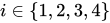
Find a linear map  with
with  for all
  .
.
Solution (Construction of a linear map)
We see that  is a basis of , namely the standard basis.
According to the theorem of linear continuation, we can construct a linear map
defined by  Now we only have to check if
  is satisfied. It is true that
  , so
, so
 Thus the condition is satisfied for each . The mapping is linear by definition, so we are done.
Exercise (Linear maps under some conditions)
Let  and
and 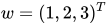 .
Is there an -linear map
.
Is there an -linear map  that satisfies
  ?
?
How to get to the proof? (Linear maps under some conditions)
First you should check if the vectors  are linearly independent. If this is the case,
  is a basis of because of
 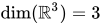 . Using the principle of linear continuation, the existence of such a linear map would follow . Let thus
  :
:
 But then also
  and so
  must be fulfilled. However, this equation has not only the "trivial" solution
  . In fact, the upper equation is satisfied for
  . Thus, one obtains
 For such a map , the relation
  would then have to hold, which is a contradiction to

Linear independence of two preimages
Exercises: Isomorphisms
Solution (complex
-vector spaces)
Set 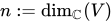 .
We choose a
.
We choose a  basis
basis  of .
Define
of .
Define  for all
  .
.
We have to show that  is an -basis of .
Then,
is an -basis of .
Then,  .
According to a theorem above, we have
.
According to a theorem above, we have  as -vector spaces.
We now show -linear independence.
Proof step: is -linearly independent
Let  and assume that
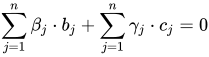 .
We substitute the definition for
.
We substitute the definition for  , conclude the sums and obtain
 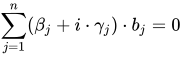 .
By -linear independence of
.
By -linear independence of  we obtain
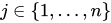
 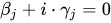 for all
  .
Thus,
.
Thus,  for all .
This establishes the -linear independence.
for all .
This establishes the -linear independence.
Now only one step is missing:
Proof step: is a generator with respect to
Let be arbitrary.
Since  is a -basis of , we can find some
  ,
such that
,
such that 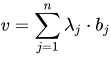 .
We write
.
We write 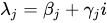 with
with  for all
  .
Then we obtain
.
Then we obtain
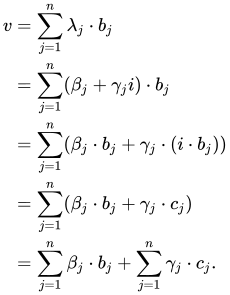 So is inside the -span of .
This establishes the assertion.
So is inside the -span of .
This establishes the assertion.
Exercise (Isomorphism criteria for endomorphisms)
Let  be a field, a finite-dimensional -vector space and
  a -linear map.
Prove that the following three statements are equivalent:
a -linear map.
Prove that the following three statements are equivalent:
(i) is an isomorphism.
(ii) is injective.
(iii) is surjective.
(Note: For this task, it may be helpful to know the terms kernel and image of a linear map. Using the dimension theorem, this exercise becomes much easier. However, we give a solution here, which works without the dimension theorem).
Solution (Isomorphism criteria for endomorphisms)
(i) (ii) and (iii): According to the definition of an isomorphism, is bijective, i.e. injective and surjective. Therefore (ii) and (iii) hold.
(ii)(i): Let be an injective mapping. We need to show that is also surjective. The image  of is a subspace of . This can be verified by calculation. We now define a mapping
  that does the same thing as , except that it will be surjective by definition. This mapping is defined as follows:
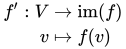 The surjectivity comes from the fact that every element
  can be written as
  , for a suitable
  . Moreover, the mapping is injective and linear. This is because already has these two properties. So and
  are isomorphic. Therefore, and have the same finite dimension. Since is a subspace of ,
  holds. This can be seen by choosing a basis in , for instance the basis given by the vectors
  . These
  are also linearly independent in , since
  . And since and have the same dimension, the are also a basis in . So the two vector spaces and must now be the same, because all elements from them are -linear combinations formed with the . Thus we have shown that is surjective.
(iii)(i): Now suppose is surjective. We need to show that is also injective. Let  be the kernel of the mapping . You may convince yourself by calculation, that this kernel is a subspace of . Let
  be a basis of
  . We can complete this (small) basis to a (large) basis of , by including the additional vectors
  . We will now show that
  are linearly independent. So let coefficients
  be given such that
 By linearity of we conclude:
  . This means that the linear combination
 is in the kernel of . But we already know a basis of . Therefore there are coefficients
  , such that
 Because of the linear independence of it now follows that
  . Therefore, the are linearly independent. Next, we will show that these vectors also form a basis of . To do this, we show that each vector in can be written as a linear combination of the . Let
  . Because of the surjectivity of , there is a , with
  . Since the form a basis of , there are coefficients
  such that
 If we now apply to this equation, we get:
 Here we used the linearity of . Since the first
  elements of our basis are in the kernel, their images are
  . So we get the desired representation of :
 Thus we have shown that forms a linearly independent generator of . So these vectors form a basis of . Now if were not , two finite bases in would not contain equally many elements. This cannot be the case. Therefore,
  , so is the trivial vector space and is indeed injective.
Solution (Function spaces)
We already know according to a theorem above that two finite dimensional vector spaces are isomorphic exactly if they have the same dimension. So we just need to show that  holds.
To show this, we first need a basis of  . For this, let
  be the elements of the set
  . We define
  by
by
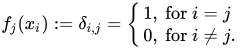 We now show that the functions
  indeed form a basis of .
Proof step: are linearly independent
Let  with
with 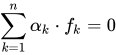 being the zero function. If we apply this function to any
  with , then we obtain:
 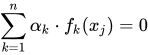 . By definition of it follows that
 .
Since was arbitrary and must hold for all
.
Since was arbitrary and must hold for all  , it follows that
  . So we have shown that are linearly independent.
Proof step: generate
Let  be arbitrary. We now want to write
  as a linear combination of . For this we show
 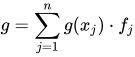 , i.e., is a linear combination of with coefficients
  .
We now verify that
.
We now verify that 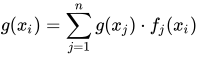 for all
 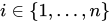 . Let be arbitrary. By definition of we obtain:
 .
Since equality holds for all
.
Since equality holds for all  , the functions agree at every point and are therefore identical. So we have shown that generate .
Thus we have proved that is a basis of . Since we have  basis elements of , it follows that
  .
.
Exercises: Images
Solution (Associating image spaces to figures)
First we look for the image of :
To find  , we can apply a theorem from above: If
  is a generator of , then
  holds. We take the standard basis
  as the generator of . Then
 Now we apply to the standard basis
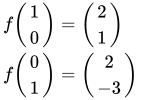 The vectors
  generate the image of . Moreover, they are linearly independent and thus a basis of .
Therefore
generate the image of . Moreover, they are linearly independent and thus a basis of .
Therefore  . So
. So  .
.
Next, we want to find the image of . However, it is also possible to compute the image  directly by definition, which we will demonstrate here.
![{\displaystyle {\begin{aligned}\operatorname {im} (g)&=\left\{g{\begin{pmatrix}x\\y\end{pmatrix}}\mid {\begin{pmatrix}x\\y\end{pmatrix}}\in \mathbb {R} ^{2}\right\}\\&=\left\{{\begin{pmatrix}x\\2x\end{pmatrix}}\mid {\begin{pmatrix}x\\y\end{pmatrix}}\in \mathbb {R} ^{2}\right\}\\&=\left\{x{\begin{pmatrix}1\\2\end{pmatrix}}\mid {\begin{pmatrix}x\\y\end{pmatrix}}\in \mathbb {R} ^{2}\right\}\\&{\color {OliveGreen}\left\downarrow \ {\text{The left side does not depend on }}y\right.}\\[0.3em]&=\left\{x{\begin{pmatrix}1\\2\end{pmatrix}}\mid x\in \mathbb {R} \right\}\\&=\operatorname {span} \left({\begin{pmatrix}1\\2\end{pmatrix}}\right)\end{aligned}}}](./_assets_/eb734a37dd21ce173a46342d1cc64c92/4b63f3b015c4e5b1be6027194521ccf14c6e0276.svg) So the image of is spanned by the vector
So the image of is spanned by the vector  . Thus
  .
.
Now we determine the image of  using, for example, the same method as for . That means we apply to the standard basis:
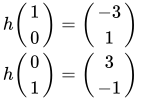 Both vectors are linearly dependent. So it follows that
  and thus
  .
.
Finally, we determine the image of . For this we proceed for example as with .
![{\displaystyle {\begin{aligned}\operatorname {im} (k)&=\left\{k{\begin{pmatrix}x\\y\end{pmatrix}}\mid {\begin{pmatrix}x\\y\end{pmatrix}}\in \mathbb {R} ^{2}\right\}\\&=\left\{{\begin{pmatrix}x\\0\end{pmatrix}}\mid {\begin{pmatrix}x\\y\end{pmatrix}}\in \mathbb {R} ^{2}\right\}\\&=\left\{x{\begin{pmatrix}1\\0\end{pmatrix}}\mid {\begin{pmatrix}x\\y\end{pmatrix}}\in \mathbb {R} ^{2}\right\}\\&{\color {OliveGreen}\left\downarrow \ {\text{The left side does not depend on }}y\right.}\\[0.3em]&=\left\{x{\begin{pmatrix}1\\0\end{pmatrix}}\mid x\in \mathbb {R} \right\}\\&=\operatorname {span} \left({\begin{pmatrix}1\\0\end{pmatrix}}\right)\end{aligned}}}](./_assets_/eb734a37dd21ce173a46342d1cc64c92/e5acc43adc661ee1cd1beb09cd1b2adf70cd11ab.svg) So the image of is spanned by the vector
So the image of is spanned by the vector  . Thus
  is the
  -axis, so
  .
.
Exercise (Image of a matrix)
- Consider the matrix
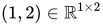 and the mapping
  induced by it. What is the image ?
- Now let
 be any matrix over a field , where
  denote the columns of
  . Consider the mapping
  induced by . Show that
  holds. So the image of a matrix is the span of its columns.
Solution (Image of a matrix)
Solution sub-exercise 2:
Proof step: " "
"
Let  . Then, there is some
  with
with  . We can write as
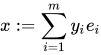
  . Plugging this into the equation , we get.
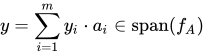
![{\displaystyle {\begin{aligned}y&=Ax\\&{\color {OliveGreen}\left\downarrow \ x=\sum _{i=1}^{m}x_{i}e_{i}\right.}\\[0.3em]&=A\left(\sum _{i=1}^{m}x_{i}e_{i}\right)\\[0.3em]&{\color {OliveGreen}\left\downarrow \ {\text{application of }}A{\text{ is linear}}\right.}\\[0.3em]&=\sum _{i=1}^{m}x_{i}Ae_{i}\\[0.3em]&{\color {OliveGreen}\left\downarrow \ Ae_{i}=a_{i}{\text{, the }}i{\text{-th column of }}A\right.}\\[0.3em]&=\sum _{i=1}^{m}x_{i}a_{i}.\end{aligned}}}](./_assets_/eb734a37dd21ce173a46342d1cc64c92/33a00acb8541db4c18d0e1d4dfc0914f1841aa3a.svg)
Since 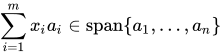 , we obtain
  .
.
Proof step: " "
"
Exercise (Surjectivity and dimension of
and

)
Let and be two finite-dimensional vector spaces. Show that there exists a surjective linear map  if and only if
  .
.
How to get to the proof? (Surjectivity and dimension of
and
)
We want to estimate the dimensions of and against each other. The dimension is defined as the cardinality of a basis. That is, if  is a basis of and
  is a basis of , we must show that
  holds if and only if there exists a surjective linear map. "if and only if" means that we need to establish two directions (
 ).
).
Given a surjective linear map , we must show that the dimension of is at least  . Now bases are maximal linearly independent subsets. That is, to estimate the dimension from below, we need to construct a linearly independent subset with elements. In the figure, we have already a linearly independent subset with elements, which is the basis . Because is surjective, we can lift these to vectors
  with
with  . Now we need to verify that
  are linearly independent in . We see this, by converting a linear combination
  via into a linear combination
  and exploiting the linear independence of .
Conversely, if holds, we must construct a surjective linear map . Following the principle of linear continuation, we can construct the linear map by specifying how acts on a basis of . For this we need elements of on which we can send . We have already chosen a basis of above. Therefore, it is convenient to define as follows:
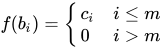
Then the image of is spanned by the vectors  . However, these vectors also span all of and thus is surjective.
Solution (Surjectivity and dimension of
and
)
Proof step: " "
"
Suppose there is a suitable surjective mapping . We show that the dimension of 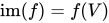 cannot be larger than the dimension of (this is true for any linear map). Because of the surjectivity of , it follows that
  .
.
So let  be linearly independent. There exists
  with
with  for
for 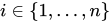 . We show that
  are also linearly independent: Let
  with
with  . Then we also have that
 By linear independence of
  , it follows that
  . So are also linearly independent. Overall, we have shown that
 In particular, it holds that a basis of (a maximal linearly independent subset of ) must contain at least as many elements as a basis of , that is,
  .
.
Proof step: " "
"
Assume that . We use that a linear map is already uniquely determined by the images of the basis vectors. Let 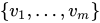 be a basis of and
 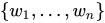 be a basis of . Define the surjective linear map by
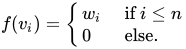 This works, since by assumption, holds. The mapping constructed in this way is surjective, since by construction,
  . As the image of is a subspace of , the subspace generated by these vectors, i.e., , also lies in the image of . Accordingly,
  holds and is surjective.
Exercises: Kernel
Exercise
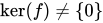
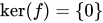
We consider the linear map  . Determine the kernel of .
Solution
We are looking for vectors  such that
 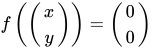 . Let
. Let  be any vector in for which is true. We now examine what properties this vector must have. It holds that

So 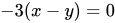 and
and  . From this we conclude
  . So any vector in the kernel of satisfies the condition .
Now take a vector
. So any vector in the kernel of satisfies the condition .
Now take a vector  with
with  . Then
 We see that
  . In total
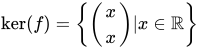
Check your understanding: Can you visualize

in the plane? What does the image of
look like? How do the kernel and the image relate to each other?
We have already seen that

Now we determine the image of by applying to the canonical basis.
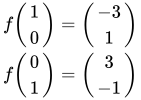 So
So  holds.
We see that the two vectors are linearly dependent. That is, we can generate the image with only one vector:
holds.
We see that the two vectors are linearly dependent. That is, we can generate the image with only one vector:  .
.
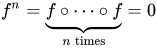
In our example, the image and the kernel of the linear map are straight lines through the origin. The two straight lines intersect only at the zero and together span the whole .
Solution
Proof step: nilpotent 
Proof step: The converse implication
The converse implication does not hold. There are mappings that are neither injective nor nilpotent. For example we can define
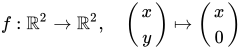 This mapping is not injective, because
 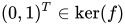 . But it is also not nilpotent, because we have
  for all
  .
.
Exercise (Injectivity and dimension of
and
)
Let and be two finite-dimensional vector spaces. Show that there exists an injective linear map if and only if  .
.
How to get to the proof? (Injectivity and dimension of
and
)
To prove equivalence, we need to show two implications. For the execution, we use that every monomorphism preserves linear independence: If  is a basis of , then the vectors
  are linearly independent. For the converse direction, we need to construct a monomorphism from to using the assumption
  . To do this, we choose bases in and and then use the principle of linear continuation to define a monomorphism by the images of the basis vectors.
Solution (Injectivity and dimension of
and
)
Proof step: There is a monomorphism 
Let  be a monomorphism and
  a basis of . Then is in particular linearly independent and therefore
  is linearly independent. Thus, it follows that
  . So
. So  is a necessary criterion for the existence of a monomorphism from to .
Proof step:  there is a monomorphism
Conversely, in the case we can construct a monomorphism: Let  be a basis of and
 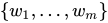 be a basis of . Then
  . We define a linear map by setting
for all
. We define a linear map by setting
for all  . According to the principle of linear continuation, such a linear map exists and is uniquely determined. We now show that is injective by proving that
 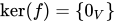 holds. Let
  . Because is a basis of , there exist some with
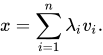
Thus, we get
![{\displaystyle {\begin{aligned}0_{V}=f(x)&=f\left(\sum _{i=1}^{n}\lambda _{i}v_{i}\right)\\[0.3em]&\ {\color {OliveGreen}\left\downarrow \ f{\text{ is linear}}\right.}\\[0.3em]&=\sum _{i=1}^{n}\lambda _{i}f(v_{i})\\[0.3em]&\ {\color {OliveGreen}\left\downarrow \ f(v_{i})=w_{i}\right.}\\[0.3em]&=\sum _{i=1}^{n}\lambda _{i}w_{i}\\[0.3em]&\ {\color {OliveGreen}\left\downarrow \ \lambda _{i}=0{\text{ for }}i>n\right.}\\[0.3em]&=\sum _{i=1}^{m}\lambda _{i}w_{i}\end{aligned}}}](./_assets_/eb734a37dd21ce173a46342d1cc64c92/f49ed4d7691d3d680772c9681d2416c4673412cf.svg)
Since are linearly independent,  must hold for all . So it follows for that
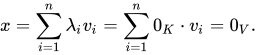 We have shown that holds and thus is a monomorphism.
Fehler: Aktuelle Seite wurde in der Sitemap nicht gefunden. Deswegen kann keine Navigation angezeigt werden



![{\displaystyle {\begin{aligned}f(v+w)&=\\[0.3em]&=\ f\left({\begin{pmatrix}v_{1}\\v_{2}\\v_{3}\end{pmatrix}}+{\begin{pmatrix}w_{1}\\w_{2}\\w_{3}\end{pmatrix}}\right)=f{\begin{pmatrix}v_{1}+w_{1}\\v_{2}+w_{2}\\v_{3}+w_{3}\end{pmatrix}}\\[0.3em]&{\color {OliveGreen}\left\downarrow \ {\text{definition of }}f\right.}\\[0.3em]&=\ 5(v_{1}+w_{1})+(v_{2}+w_{2})-3(v_{3}+w_{3})\\[0.3em]&{\color {OliveGreen}\left\downarrow \ {\text{distributivity in }}\mathbb {R} \right.}\\[0.3em]&=\ 5v_{1}+5w_{1}+v_{2}+w_{2}-3v_{3}-3w_{3}\\[0.3em]&{\color {OliveGreen}\left\downarrow \ {\text{commutativity and associativity in }}\mathbb {R} \right.}\\[0.3em]&=\ (5v_{1}+v_{2}-3v_{3})+(5w_{1}+w_{2}-3w_{3})\\[0.3em]&{\color {OliveGreen}\left\downarrow \ {\text{definition of }}f\right.}\\[0.3em]&=\ f{\begin{pmatrix}v_{1}\\v_{2}\\v_{3}\end{pmatrix}}+f{\begin{pmatrix}w_{1}\\w_{2}\\w_{3}\end{pmatrix}}=f(v)+f(w)\end{aligned}}}](./_assets_/eb734a37dd21ce173a46342d1cc64c92/f77bbdc5a26857c2afd43f231f55be3fd850ceae.svg)
![{\displaystyle {\begin{aligned}f(\lambda \cdot v)&=f\left(\lambda \cdot {\begin{pmatrix}v_{1}\\v_{2}\\v_{3}\end{pmatrix}}\right)=f{\begin{pmatrix}\lambda v_{1}\\\lambda v_{2}\\\lambda v_{3}\end{pmatrix}}\\[0.3em]&{\color {OliveGreen}\left\downarrow \ {\text{definition of }}f\right.}\\[0.3em]&=\ 5(\lambda v_{1})+(\lambda v_{2})-3(\lambda v_{3})\\[0.3em]&{\color {OliveGreen}\left\downarrow \ {\text{associativity of the multiplication in }}\mathbb {R} \right.}\\[0.3em]&=\ \lambda \cdot (5v_{1})+\lambda \cdot (v_{2})-\lambda \cdot (3v_{3})\\[0.3em]&{\color {OliveGreen}\left\downarrow \ {\text{distributivity in }}\mathbb {R} \right.}\\[0.3em]&=\ \lambda \cdot (5v_{1}+v_{2}-3v_{3})\\[0.3em]&{\color {OliveGreen}\left\downarrow \ {\text{definition of }}f\right.}\\[0.3em]&=\ \lambda \cdot f{\begin{pmatrix}v_{1}\\v_{2}\\v_{3}\end{pmatrix}}=\lambda \cdot f(v)\end{aligned}}}](./_assets_/eb734a37dd21ce173a46342d1cc64c92/bc890ee8ef9ccb0970e44a221e7fc7b13f6a4430.svg)






![{\displaystyle {\begin{aligned}f\left({\begin{pmatrix}x_{1}\\x_{2}\end{pmatrix}}+{\begin{pmatrix}y_{1}\\y_{2}\end{pmatrix}}\right)&=f{\begin{pmatrix}x_{1}+y_{1}\\x_{2}+y_{2}\end{pmatrix}}\\[0.3em]&{\color {OliveGreen}\left\downarrow \ {\text{definition of }}f\right.}\\[0.3em]&={\begin{pmatrix}(x_{1}+y_{1})+(x_{2}+y_{2})\\(x_{1}+y_{1})-5\cdot (x_{2}+y_{2})\end{pmatrix}}\\[0.3em]&{\color {OliveGreen}\left\downarrow \ {\text{distributive law}}\right.}\\[0.3em]&={\begin{pmatrix}(x_{1}+x_{2})+(y_{1}+y_{2})\\(x_{1}-5x_{2})+(y_{1}-5y_{2})\end{pmatrix}}\\[0.3em]&{\color {OliveGreen}\left\downarrow \ {\text{separate vectors}}\right.}\\[0.3em]&={\begin{pmatrix}x_{1}+x_{2}\\x_{1}-5x_{2}\end{pmatrix}}+{\begin{pmatrix}y_{1}+y_{2}\\y_{1}-5y_{2}\end{pmatrix}}\\[0.3em]&{\color {OliveGreen}\left\downarrow \ {\text{definition of }}f\right.}\\[0.3em]&=f{\begin{pmatrix}x_{1}\\x_{2}\end{pmatrix}}+f{\begin{pmatrix}y_{1}\\y_{2}\end{pmatrix}}\end{aligned}}}](./_assets_/eb734a37dd21ce173a46342d1cc64c92/7cd5078e54419cba46cca936b78489a8e2acbda5.svg)






![{\displaystyle {\begin{aligned}\Theta (g+h)(n)&=\\[0.3em]&{\color {OliveGreen}\left\downarrow \ {\text{definition of }}\Theta \right.}\\[0.3em]&=\ ((g+h)\circ t)(n)\\[0.3em]&=\ (g+h)(t(n))\\[0.3em]&{\color {OliveGreen}\left\downarrow \ {\text{vector addition on Fun}}(M,V)\right.}\\[0.3em]&=\ g(t(n))+h(t(n))\\[0.3em]&=\ (g\circ t)(n)+(h\circ t)(n)\\[0.3em]&{\color {OliveGreen}\left\downarrow \ {\text{definition of }}\Theta \right.}\\[0.3em]&=\ \Theta (g)(n)+\Theta (h)(n)\\[0.3em]&{\color {OliveGreen}\left\downarrow \ {\text{vector addition on Fun}}(N,V)\right.}\\[0.3em]&=\ (\Theta (g)+\Theta (h))(n)\end{aligned}}}](./_assets_/eb734a37dd21ce173a46342d1cc64c92/b245dfefd40ab7d54e7a1d6d9525433e4b5f91fa.svg)
![{\displaystyle {\begin{aligned}\Theta (\lambda \cdot g)(n)&=\\[0.3em]&{\color {OliveGreen}\left\downarrow \ {\text{definition of }}\Theta \right.}\\[0.3em]&=\ ((\lambda \cdot g)\circ t)(n)\\[0.3em]&=\ (\lambda \cdot g)(t(n))\\[0.3em]&{\color {OliveGreen}\left\downarrow \ {\text{scalar multiplication on Fun}}(M,V)\right.}\\[0.3em]&=\ \lambda \cdot g(t(n))\\[0.3em]&=\ \lambda \cdot (g\circ t)(n)\\[0.3em]&{\color {OliveGreen}\left\downarrow \ {\text{definition of }}\Theta \right.}\\[0.3em]&=\ \lambda \cdot \Theta (g)(n)\\[0.3em]&{\color {OliveGreen}\left\downarrow \ {\text{scalar multiplication on Fun}}(N,V)\right.}\\[0.3em]&=\ (\lambda \cdot \Theta (g))(n)\end{aligned}}}](./_assets_/eb734a37dd21ce173a46342d1cc64c92/1797bd9688f447cc3890be45f8ff7f30995dd953.svg)